Hamilton Township Property Tax Records
Hamilton Township property tax records are maintained by the local tax assessor and the Mercer County Board of Taxation. Hamilton is the most populous municipality in Mercer County with approximately 92,000 residents. It borders the state capital of Trenton and sits in the geographic center of the county. Property records here cover assessments, tax maps, deduction applications, and appeal filings. The Mercer County Board of Taxation oversees property tax administration for all 12 municipalities in the county, including Hamilton.
Hamilton Township Quick Facts
Mercer County Tax Board
The Mercer County Board of Taxation administers the property tax system for Hamilton Township and the other 11 municipalities in the county. The board is responsible for hearing tax appeals, maintaining equalization tables, and publishing annual tax data. Under N.J.S.A. 54:3-21, the board serves as the first level of appeal for any Hamilton Township property owner who disputes their assessment.
The board's office is located in Trenton, the county seat. It publishes equalization ratios, tax lists, and appeal forms each year. The equalization process ensures that property values across all 12 Mercer County towns are treated fairly when county and school taxes are apportioned. Hamilton's large tax base makes it a significant factor in county-wide equalization. You can find contact details and forms at the Mercer County Board of Taxation website.
Each municipality in Mercer County has its own tax assessor who sets local assessments. The board reviews the assessor's work through the equalization process and resolves disputes that are filed as formal appeals. Records from these proceedings are public under N.J.S.A. 47:1A-1, the Open Public Records Act. Anyone can request copies of appeal decisions, equalization tables, and related tax documents.
Note: The Mercer County Board of Taxation handles appeals from all 12 municipalities. Hamilton Township typically accounts for a large share of annual filings given its size.
Hamilton Township Tax Searches
Several online tools let you search property tax records for Hamilton Township. The site taxrecords-nj.com covers Mercer County and lets you look up any parcel in Hamilton by owner name, property address, or block and lot. Results display assessed values, annual tax amounts, and property classifications. This is one of the fastest ways to pull basic tax data for a Hamilton Township property.
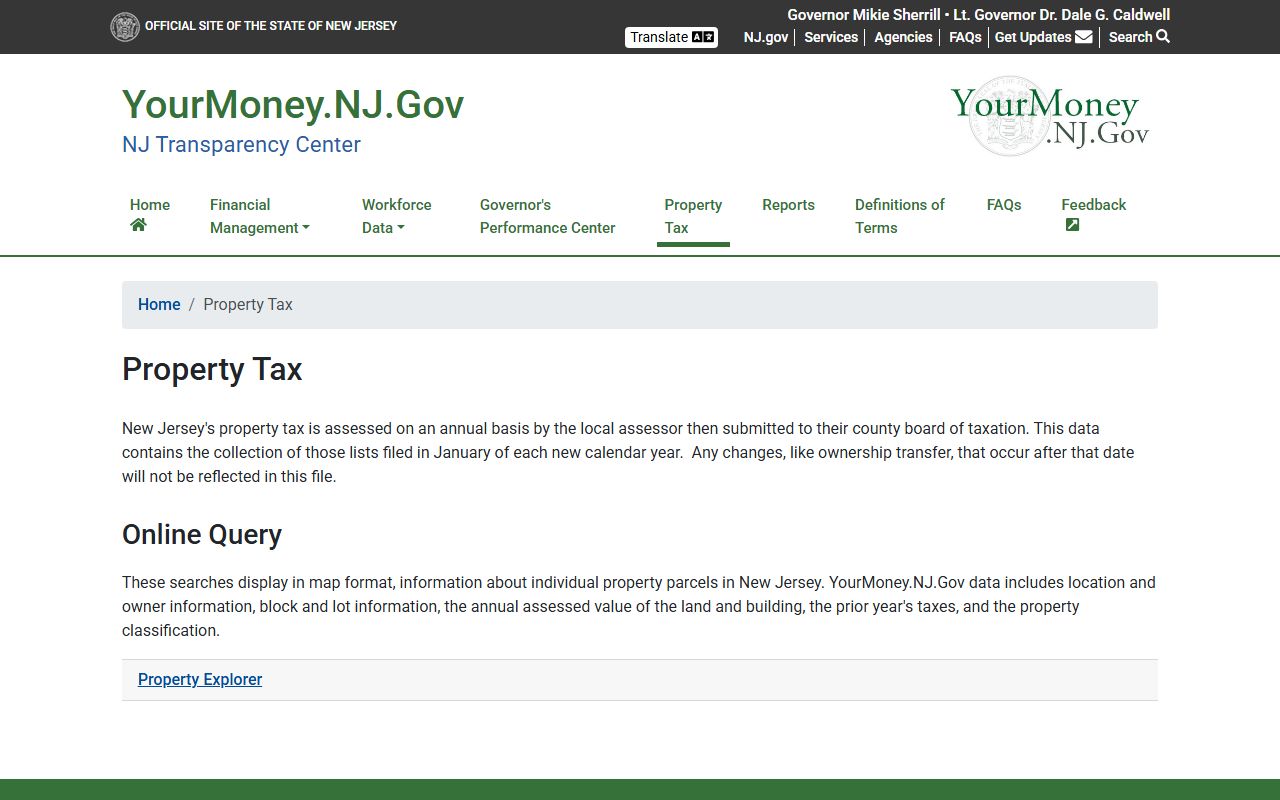
The New Jersey Property Tax Explorer at nj.gov/transparency/property provides aggregate data for every municipality. You can view Hamilton Township's average residential tax bill, total ratables, and year-over-year changes. The tool is useful for comparing Hamilton to neighboring towns like Trenton, Lawrence, or Robbinsville. Data comes from the Division of Taxation and is updated annually after tax rates are certified.
For in-person searches, the Hamilton Township tax assessor's office maintains property record cards for every parcel. These cards list the assessed value breakdown between land and improvements, lot dimensions, building details, and any exemptions or deductions on file. You can visit the office during business hours and request a copy of your tax card. Bring your block and lot number for a faster lookup.
Tax Appeals in Hamilton
Hamilton Township residents can challenge their property tax assessment each year by filing an appeal with the Mercer County Board of Taxation. The standard deadline is April 1 under N.J.S.A. 54:3-21. If the township has undergone a revaluation, the deadline moves to May 1. The board does not extend these dates for any reason.
To file, you need a completed appeal petition and a copy of your current assessment notice or tax card from the Hamilton Township assessor. The form asks for your property's block and lot, current assessment, and the value you believe is correct. You should also include evidence that supports your claimed value. Comparable sales from the past year are the strongest form of evidence. Three to five sales of similar properties in Hamilton Township make a solid case.
The board schedules a hearing where you present your case. The township assessor or attorney may also appear. After hearing both sides, the board issues a judgment. If it reduces your assessment, the change applies to the current tax year. If the board denies your appeal or you disagree with the result, you can file with the New Jersey Tax Court under N.J.S.A. 54:51A-1.
Hamilton Property Assessment Process
The Hamilton Township tax assessor sets the assessed value of every property in the township. N.J.S.A. 54:4-23 requires that all real property be assessed at true value. The assessor inspects properties, reviews building permits, and tracks market conditions to keep values current. When a homeowner adds a room or builds a deck, the assessor may increase the assessment to reflect the added value.
Assessment records break each property into two parts: land value and improvement value. Land value reflects the lot's size, location, and permitted use under the zoning code. Improvement value covers the house or other structures. The general tax rate, set each year by the county, is applied to the total assessment to produce the annual tax bill. Hamilton's tax rate is published as a dollar amount per $100 of assessed value.
The New Jersey Division of Taxation publishes statewide assessment data and guidance at nj.gov/treasury/taxation. This resource explains how tax rates are calculated, what common ratios mean, and how the equalization process works. It is helpful for Hamilton Township owners who want to understand how their tax bill is computed and whether their assessment is in line with market value.
Hamilton also maintains official tax maps that show every lot with boundary lines, block and lot numbers, and dimensions. These maps are public records used in real estate closings, title searches, and land use applications. The assessor's office can provide copies.
Note: When Hamilton Township's equalization ratio drifts significantly from 100%, the state may order a reassessment or revaluation to bring all property values in line with current market conditions.
Hamilton Tax Relief Programs
Hamilton Township residents may qualify for several state property tax relief programs. These include deductions, exemptions, and reimbursement programs. Applications are handled by the Hamilton Township tax assessor's office. Each program has its own rules for eligibility, income limits, and filing deadlines.
The veteran's deduction under N.J.S.A. 54:4-3.30 provides a $250 annual reduction for qualifying veterans. The senior citizen and disabled person deduction under N.J.S.A. 54:4-8.40 also provides $250 per year to those who meet the age and income requirements. Disabled veterans with a 100% disability rating may qualify for a full exemption from property taxes. All of these must be applied for through the local assessor.
- Veteran's $250 deduction requires active duty service and honorable discharge
- Senior (65+) and disabled person deduction requires income below the statutory limit
- 100% disabled veteran exemption eliminates the full tax bill
- Senior Freeze (PTR) reimburses eligible seniors for tax increases above their base year
- ANCHOR program provides relief payments to homeowners and renters
- Stay NJ targets additional relief for residents 65 and older
The state has launched a new single combined application that covers the Senior Freeze, ANCHOR, and Stay NJ programs for residents who are 65 or older or who receive Social Security Disability benefits. This combined form simplifies the process for Hamilton Township residents who may be eligible for more than one program. Previously, each program required a separate application with different deadlines and different supporting documents.
The Hamilton tax assessor's office can explain which programs you may qualify for and provide the correct forms. Applications for the senior and disabled deduction must be filed by December 31 of the pre-tax year. Do not miss the deadline because late applications are not accepted.
Hamilton Township Tax Assessor
The Hamilton Township tax assessor's office is the starting point for most property tax matters in the township. The assessor sets values, processes deduction applications, and maintains property record cards and tax maps. If you have questions about your assessment, this is the office to contact first.
The assessor is also responsible for processing added assessments when new construction is completed or when existing properties are improved. Under N.J.S.A. 54:4-63.1 through 63.38, added assessments capture the value of improvements completed during the tax year. If you build a new home or add to your house in Hamilton, you may receive an added assessment notice in addition to your regular tax bill.
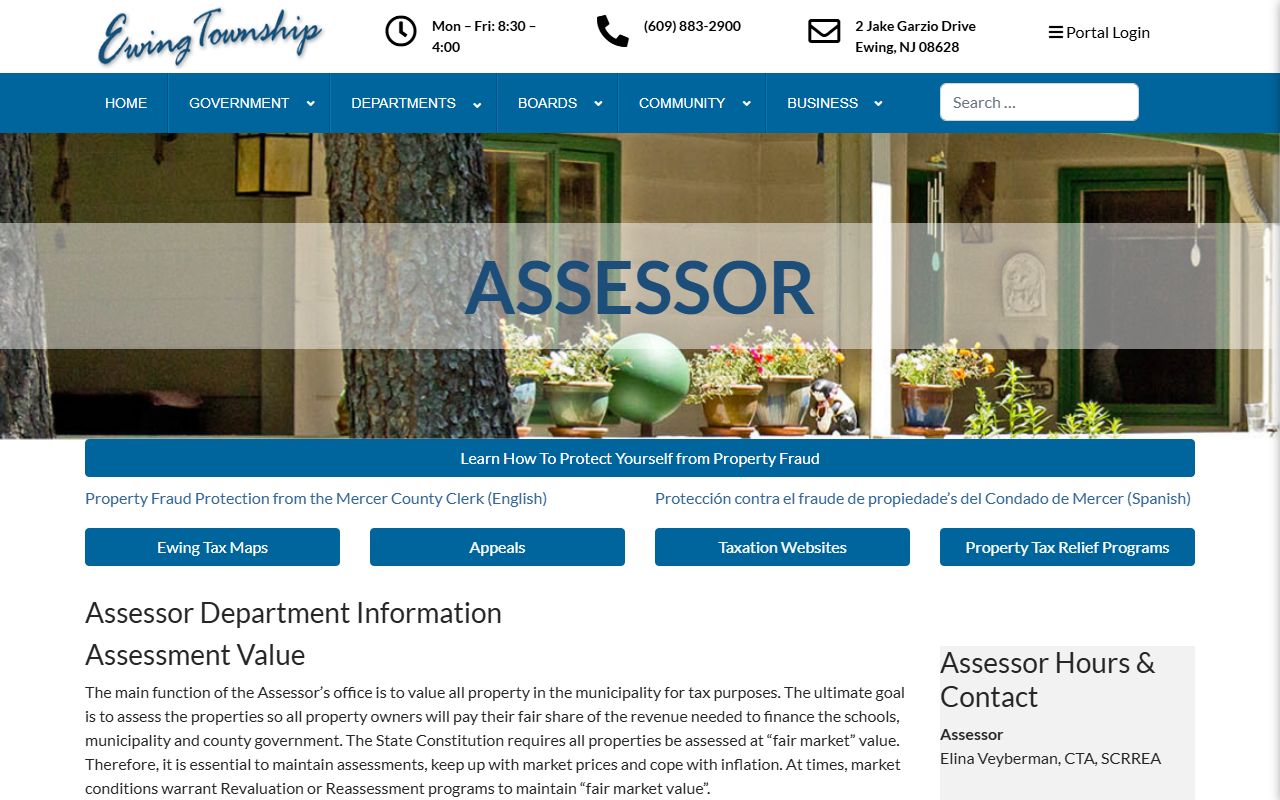
Neighboring municipalities in Mercer County, such as Ewing Township, handle the same functions through their own assessors. The Ewing Township Tax Assessor website is one example of how local offices share information about deductions, exemptions, and the assessment calendar. Hamilton Township's assessor provides similar information and can be reached through the township's main office.
Mercer County Property Tax Records
Hamilton Township is part of Mercer County, which administers property tax oversight for all 12 municipalities through its Board of Taxation. The county board handles appeals, equalization, and annual tax data publication. For county-wide property tax information, appeal procedures, and links to additional resources, visit the Mercer County property tax records page.