Toms River Property Tax Records
Toms River Township property tax records are managed through the Ocean County Board of Taxation and the local tax assessor. Toms River serves as the county seat of Ocean County, one of the largest counties in New Jersey by land area. The township has roughly 95,000 residents and sits along the Toms River and Barnegat Bay. Property tax records here include assessments, tax maps, sales ratio data, and appeal filings. Ocean County oversees tax administration for 33 municipalities, with Toms River at its center.
Toms River Quick Facts
Ocean County Tax Board Records
The Ocean County Board of Taxation is the main office for property tax oversight in Toms River and all 33 municipalities in the county. The board sits at the Washington Street Courthouse in Toms River. It handles tax appeals, equalization tables, and added assessment reviews. Under N.J.S.A. 54:3-21, any property owner in Toms River can file an appeal if they believe their assessment is too high.
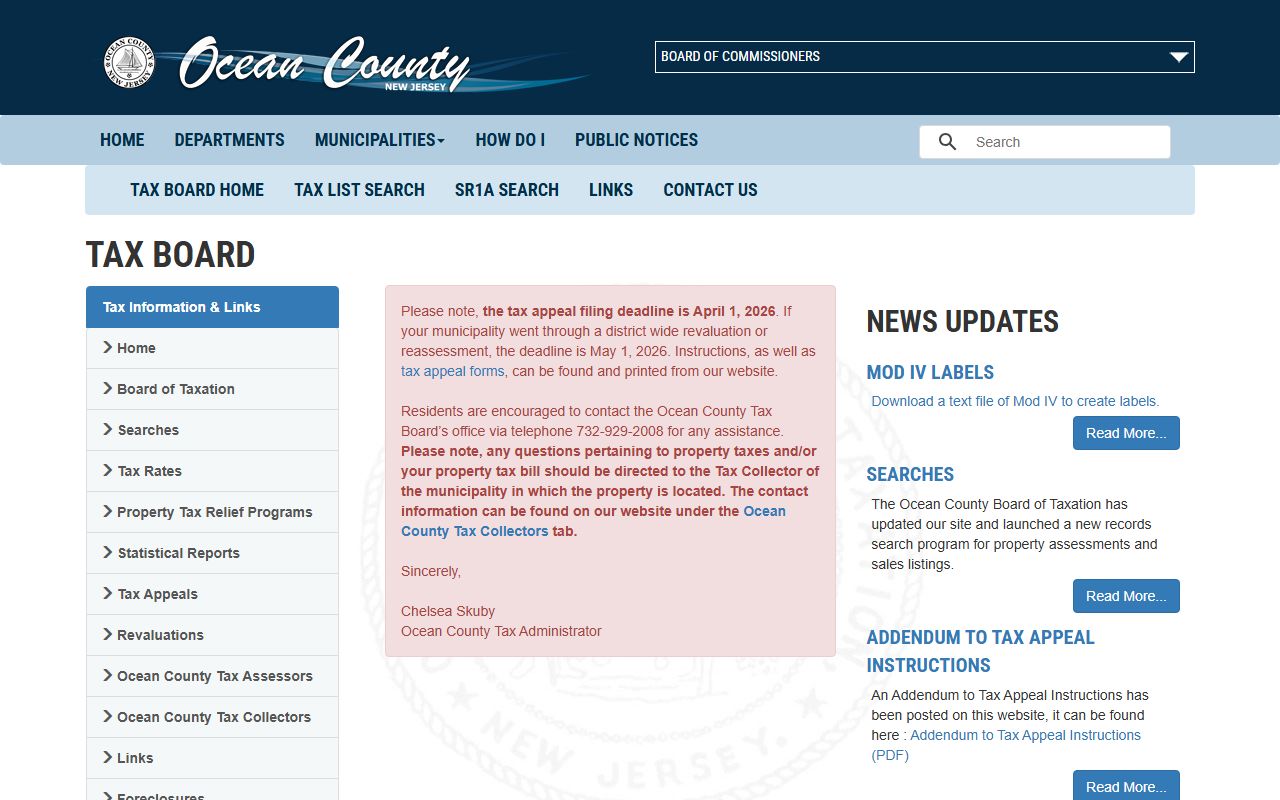
The board keeps records of every tax appeal filed in the county. These records show the original assessment, the claimed value, and the board's final decision. Each year the board also publishes county equalization data that shows how each town's tax base compares to true market value. This data is public and helps explain why tax rates differ across Ocean County towns. You can reach the board through its site at tax.co.ocean.nj.us for forms, deadlines, and contact details.
Tax appeal deadlines are strict. In most years, the filing deadline is April 1 under N.J.S.A. 54:3-21. If Toms River or another Ocean County town undergoes a revaluation or reassessment, the deadline shifts to May 1. The board does not grant extensions. Late filings are dismissed. Taxpayers must use the correct form and include a copy of the current tax card from the local assessor when they file.
Note: The Washington Street Courthouse also houses the Ocean County Clerk, which keeps deeds and other land records for Toms River properties.
Toms River Property Tax Searches
There are several ways to look up property tax records in Toms River. The most direct online tool is taxrecords-nj.com, which lets you search by owner name, address, or block and lot number. This site covers all of Ocean County, including every parcel in Toms River Township. Results show assessed values, tax amounts, and property details pulled from official records.
The State of New Jersey also runs the Property Tax Explorer on its transparency portal. This tool displays tax data for every municipality in the state. You can look at Toms River's average tax bill, compare it to other Ocean County towns, and view trends over time. The data comes from the Division of Taxation and is updated each year after final tax rates are set.
For real estate sales data, the Ocean County Board of Taxation provides the SR1A Sales Search tool at tax.co.ocean.nj.us. Every property sale in New Jersey requires an SR1A form to be filed. This form lists the sale price, date, property type, and other key details. The Ocean County SR1A search lets you pull sales records for Toms River by date range, property class, or block and lot. Real estate agents, appraisers, and tax appeal attorneys all use this tool to find comparable sales data.
You can also get records in person at the Toms River tax assessor's office. Staff can print tax cards, provide assessment history, and explain how values were set. Bring your block and lot number if you have it. That speeds up the search.
Tax Appeals in Toms River
Property owners in Toms River have the right to challenge their assessment each year. The process starts at the Ocean County Board of Taxation. You must file by April 1 for most years, or by May 1 if the township completed a revaluation. N.J.S.A. 54:3-21 sets out the rules. The appeal form is available from the board's site or at the courthouse.
To win an appeal, you need to show that your assessment does not reflect true market value. The most common way to do this is with recent comparable sales in your area. Three to five sales of similar homes within one mile of your property over the past year make the strongest case. You can also submit an appraisal from a licensed appraiser. The board will review your evidence and the assessor's data, then make a ruling.
If the board denies your appeal, you can take the case to the New Jersey Tax Court under N.J.S.A. 54:51A-1. The Tax Court hears cases from all 21 counties. Filing in Tax Court involves a separate complaint and additional requirements including a formal appraisal for properties assessed above a certain threshold. Most residential cases in Toms River are resolved at the county board level.
Note: An appeal only challenges the assessed value, not the tax rate itself. The tax rate is set by the combined budgets of the town, county, school district, and any special districts.
Toms River Property Assessments
The Toms River tax assessor determines the assessed value of every parcel in the township. Under N.J.S.A. 54:4-23, all real property must be assessed at true value. In practice, assessments can drift over time as market conditions change. The county equalization ratio adjusts for this gap. When the ratio drops too far from 100%, the state may order a revaluation.
Assessment records for Toms River show the land value and improvement value separately. The land value reflects the lot size, location, and zoning. The improvement value covers buildings and structures on the lot. Together, they form the total assessed value. Your annual tax bill equals the total assessment multiplied by the general tax rate, which is expressed per $100 of assessed value in Ocean County.
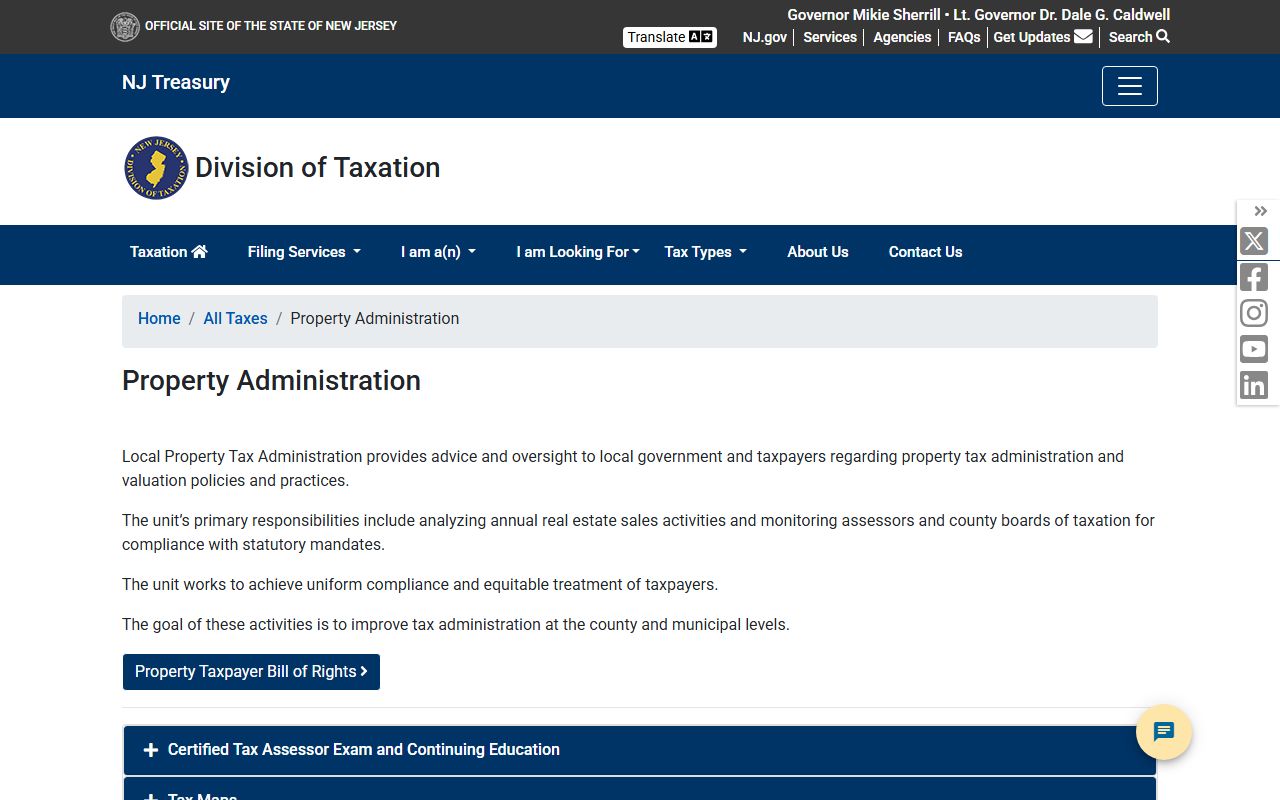
The New Jersey Division of Taxation publishes guidance on assessment practices at nj.gov/treasury/taxation. This page covers local property tax rules, common ratio data, equalization tables, and the formulas used to compute tax rates across all counties including Ocean. Anyone who owns property in Toms River can use this data to check how their assessment compares to market norms.
Toms River's tax assessor also maintains tax maps for the township. These maps show every lot with its block and lot number, dimensions, and boundary lines. Tax maps are public records and are used in title searches, zoning applications, and mortgage closings. You can request copies from the assessor's office.
Real Estate Sales Records
Every real estate sale in Toms River generates an SR1A form that is filed with the Ocean County Board of Taxation. The form captures the sale price, property class, deed reference, and buyer and seller names. Under N.J.S.A. 54:7-10, the SR1A is required for every deed that transfers property for consideration. These forms are central to the assessment process because they show what properties are actually selling for in the market.
The county uses SR1A data to calculate the sales ratio for each municipality. The sales ratio compares assessed values to actual sale prices. A ratio near 100% means assessments are close to market value. When a town's ratio falls below a set threshold, the county or state may direct a reassessment. In Toms River, this data is especially important given the volume of sales in one of Ocean County's most active real estate markets.
You can search Toms River SR1A records online through the Ocean County Board of Taxation at tax.co.ocean.nj.us. The search tool lets you filter by date, property class, and location. Results include the sale price, assessment at the time of sale, and the ratio. This is a free public tool that does not require registration.
Toms River Tax Deductions
New Jersey law provides several property tax deductions and exemptions for qualifying residents. In Toms River, applications go through the local tax assessor's office. The most common programs are the veteran's deduction, senior citizen and disabled person deduction, and full exemptions for qualifying disabled veterans under N.J.S.A. 54:4-3.30.
- Veterans receive a $250 annual deduction under N.J.S.A. 54:4-3.30
- Senior citizens (65+) and disabled persons can receive a $250 deduction under N.J.S.A. 54:4-8.40
- Disabled veterans with 100% disability may qualify for full tax exemption
- The Senior Freeze program (PTR) reimburses eligible seniors for property tax increases
- The ANCHOR program provides direct tax relief to homeowners and renters
Each program has its own income limits, age requirements, and application deadlines. The Toms River tax assessor's office can provide forms and answer questions about eligibility. Applications for the senior and disabled deduction must be filed by December 31 of the pre-tax year. Late applications are denied. Keep copies of all documents you submit.
Note: The state has introduced a single combined application for the Senior Freeze, ANCHOR, and Stay NJ programs for residents age 65 and older or those on Social Security Disability. This simplifies the process for Toms River residents who may qualify for more than one program.
Ocean County Property Tax Records
Toms River is the county seat of Ocean County, and all property tax administration flows through the county Board of Taxation. The board oversees assessments, appeals, and equalization for all 33 municipalities in the county. For more on county-wide tax data, appeal procedures, sales ratio reports, and related resources, visit the Ocean County property tax records page.