
Cumberland County Tax Records
Cumberland County property tax records are kept by local assessors and the Cumberland County Board of Taxation. The county sits in the south of New Jersey along the Delaware Bay. It has 14 municipalities, each with its own tax assessor who values real property for tax purposes. Bridgeton serves as the county seat. The Board of Taxation at 2745 S. Delsea Drive in Vineland oversees all assessment work across the county. Residents can search records through the state assessment lookup tool or contact their local tax office.
Cumberland County Quick Facts
Cumberland County Board of Taxation
The Cumberland County Board of Taxation supervises all property assessments in the county. Under N.J.S.A. 54:4-1, each property must be assessed at 100% of its true market value. The Board reviews assessment rolls from all 14 municipalities to make sure values are fair and uniform. It also hears tax appeals from property owners who believe their assessed value is wrong.
The Board has two office locations. The main office is at 2745 S. Delsea Drive in Vineland. A second location sits at 220 North Laurel Street in Bridgeton. Both are open Monday through Friday from 9:00 AM to 4:00 PM. You can call (856) 453-7425 with questions about your assessment or the appeal process. Staff can help you look up tax records and guide you through filing a petition.
| Office |
Cumberland County Board of Taxation 2745 S. Delsea Drive Vineland, NJ 08360 Phone: (856) 453-7425 |
|---|---|
| Hours | Monday through Friday, 9:00 AM to 4:00 PM |
| Website | taxrecords-nj.com |
Searching Cumberland County Tax Records
There are a few ways to look up property tax records in Cumberland County. The most direct online tool is the Assessment Records Search at taxrecords-nj.com. Select Cumberland County and then pick the right municipality. You can search by owner name, block and lot, or street address. Results show assessed values for land and improvements, the tax class, and sales history.
The state also runs a property tax lookup. Go to nj.gov/transparency/property to search tax records for any parcel in New Jersey. This tool pulls from the same data the county uses. It is free and does not need an account.
For Millville, the tax collector lets you search by owner name, location, or tax account ID on the town site. Vineland provides GIS maps through its assessor at 640 East Wood Street. The phone there is (856) 794-4031. Each town in Cumberland County may have its own tools, so check with your local office first.
Note: The Cumberland County Clerk has property deed records from 1960 to 1987 on an image viewer and 1987 to the present through an online system. In-person hours are Monday through Friday, 8:30 AM to 4:30 PM. Expect a turnaround of two to three weeks for mailed requests.
Property Assessment in Cumberland County
Each of the 14 municipalities in Cumberland County has a tax assessor. The assessor discovers, lists, and values all taxable property in the town. Under state law, all real property is to be assessed at its full and true value as of October 1 each year. The assessor then presents the final tax list to the Cumberland County Board of Taxation by January of the next year.
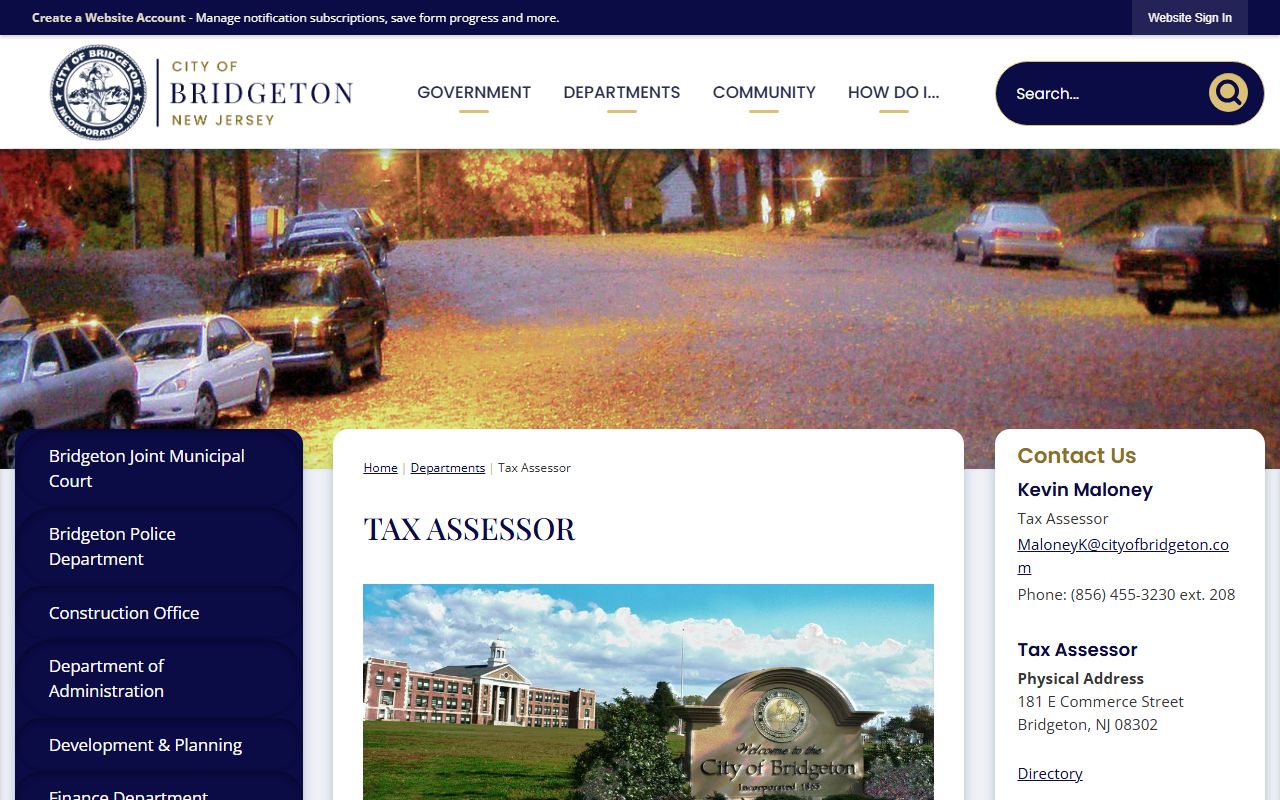
The City of Bridgeton Tax Assessor is one example. That office handles all property valuations within Bridgeton. The assessor uses recent sales, income data for commercial parcels, and the cost approach to set values. If a property sells for much more or less than its assessed value, the assessor may adjust it during the next cycle.
N.J.S.A. 54:4-1 requires that all property be assessed uniformly. The Cumberland County Board checks the common level range for each municipality. When the ratio of assessed values to sales prices drifts too far, the county can order a revaluation. This brings all properties in a town back to 100% of market value. Revaluations happen on a schedule set by the county tax administrator.
Note: P.L. 2017, c.128 changed the rules for large tax appeals. Claims above $750,000 now go straight to the Tax Court rather than the county board.
Cumberland County Tax Rates
Property tax rates in Cumberland County vary by town. Each municipality sets its own budget, and the school district and county add their portions. The total rate is the sum of all parts. Rates are expressed per $100 of assessed value.
In Bridgeton, for tax year 2023, the combined rate was $5.075 per $100 of assessed value. That breaks down as follows: the county portion was $1.222, county health was $0.068, and county open space was $0.013. The school tax was $0.751. The municipal share was $2.979, and the library tax was $0.042.
Other towns in Cumberland County will have different rates based on their own budgets and property values. The municipal portion tends to be the largest slice. You can find your town's rate on your annual tax bill or by calling the local tax collector. The New Jersey Division of Taxation at nj.gov/treasury/taxation publishes rate tables for all municipalities in the state each year.
Tax Deductions in Cumberland County
New Jersey offers several property tax deductions that apply in all Cumberland County municipalities. These reduce the amount of tax you owe each year. You must apply through your local tax assessor to receive any of them.
- Senior citizen deduction: $250 per year for homeowners age 65 or older with income under $10,000, not counting Social Security.
- Disabled person deduction: $250 per year for those who are 100% permanently and totally disabled, with income under $10,000.
- Veteran deduction: $250 per year for veterans with wartime service and an honorable discharge.
- 100% disabled veteran exemption: Full exemption from all property taxes for veterans with a total and permanent service-connected disability.
To apply, visit your local assessor in Cumberland County. Bring proof of age, disability, or military service. The assessor will verify your income and status. Once approved, the deduction stays on your account each year as long as you still qualify. If your circumstances change, you must notify the assessor.
Filing a Tax Appeal
If you think your Cumberland County property is assessed too high, you can file an appeal with the Board of Taxation. The deadline is April 1 each year, or 45 days after the date of bulk mailing of assessment notices, whichever is later. Your petition must be received by the Board on or before the deadline. A postmark is not enough.
You will need to show that your assessed value does not match the property's true market value. Gather comparable sales data to support your case. You can research comparable sales at the assessor's office or the Board of Taxation. The website njactb.org also has tools and resources for preparing an appeal.
The Board will schedule a hearing. You present your evidence, and the municipality may present its own. The Board then issues a judgment. If you disagree with the outcome, you can appeal to the New Jersey Tax Court within 45 days. More details on the state appeal process are at nj.gov/treasury/taxation.
Under P.L. 2017, c.128, if the assessed value in question is more than $750,000, the appeal goes directly to the Tax Court. You skip the county board step. This applies to commercial and high-value residential properties in Cumberland County.
Cumberland County Property Records Access
Property tax records in New Jersey are public. Under the Open Public Records Act, N.J.S.A. 47:1A-5, you can request tax records from any municipality in Cumberland County. OPRA gives you the right to inspect and copy government records. You can file a request with the local clerk or tax office.
Most property data is now online. Assessment rolls, tax lists, and sales data can all be found through the state and county search tools. For older records or documents not yet digitized, visit the Cumberland County Clerk in person. Deed records from 1960 to 1987 are on an image viewer. Records from 1987 forward are in the online system.
The Clerk's office is open Monday through Friday, 8:30 AM to 4:30 PM. If you mail a request, expect two to three weeks for a response. There is no fee to view records in person, though copy costs apply.
Municipalities in Cumberland County
Cumberland County has 14 municipalities. Each has its own tax assessor and collector. Your property tax bill comes from your local town, not the county. The assessor sets the value, the governing body sets the budget, and the collector sends your bill and takes payment.
The three largest towns are Vineland, Millville, and Bridgeton. Vineland is the biggest by both area and population. Its tax assessor is at 640 East Wood Street, and the phone number is (856) 794-4031. Millville offers online tax lookups by owner name or tax account. Bridgeton, as the county seat, houses most county offices.
Smaller municipalities in Cumberland County include Commercial Township, Deerfield Township, Downe Township, Fairfield Township, Greenwich Township, Hopewell Township, Lawrence Township, Maurice River Township, Shiloh Borough, Stow Creek Township, and Upper Deerfield Township. Each of these has a local tax assessor. Some share assessors through interlocal agreements. Contact the Board of Taxation at (856) 453-7425 if you are not sure which assessor handles your property.
Note: Tax rates differ from town to town. Two homes with the same market value in different Cumberland County municipalities will pay different amounts of tax based on local budgets and school costs.
Nearby Counties
These counties border Cumberland County. If your property is near a county line, confirm which municipality it falls in. Your tax records will be held by that municipality's assessor and the corresponding county board.