
Newark Property Tax Records Search
Newark property tax records cover the largest city in New Jersey and the county seat of Essex County. The city's Division of Assessments locates and determines the taxability of all real estate and personal property within city limits. These records include assessed values, ownership data, tax liens, and exemption status for each parcel. Property owners, prospective buyers, and researchers can access Newark tax records through both the city and the Essex County Board of Taxation. The records reflect a tax base that includes a large share of exempt land held by government agencies, schools, and nonprofit organizations.
Newark Quick Facts
Newark Assessed Values and Tax Base
The City of Newark maintains a large and varied tax base. As of 2022, the total taxable municipal valuation stood at $12,501,962,392. The tax-exempt valuation reached $10,358,056,200, which reflects the heavy presence of government and institutional land in the city. The Division of Assessments is responsible for determining the assessed value of each parcel under N.J.S.A. 54:4-23, which requires that all real property be assessed at its true value. This dual structure of taxable and exempt land shapes how property tax records look in Newark compared to other New Jersey cities.
Newark's tax-exempt land tells a distinct story. The Port Authority of New York and New Jersey alone holds more than 20.5% of the city's total land area. Other exempt holders include the Newark Housing Authority, Essex County buildings and parks, state-owned property, public school sites, federal facilities, charitable and religious organizations, hospitals, municipal property, and colleges. Under N.J.S.A. 54:4-3.6, property used for certain exempt purposes does not appear on the taxable rolls. Researchers looking into Newark property tax records will find that the exempt category is unusually large relative to the city's size.
The City of Newark Finance Department oversees the budget side of property tax collection. Assessment data feeds into the city's annual budget process and helps set the local tax rate. Property owners can review their assessed values through public records maintained by the Tax Assessor's Office.
Searching Newark Tax Records Online
Property assessments in Newark are filed with the Essex County Board of Taxation. The board maintains an online search tool that covers all municipalities in Essex County. You can look up assessed values, block and lot numbers, property class codes, and owner names for any parcel in Newark. Visit the Essex County Tax Board website to begin a search. The tool is free and does not require an account.
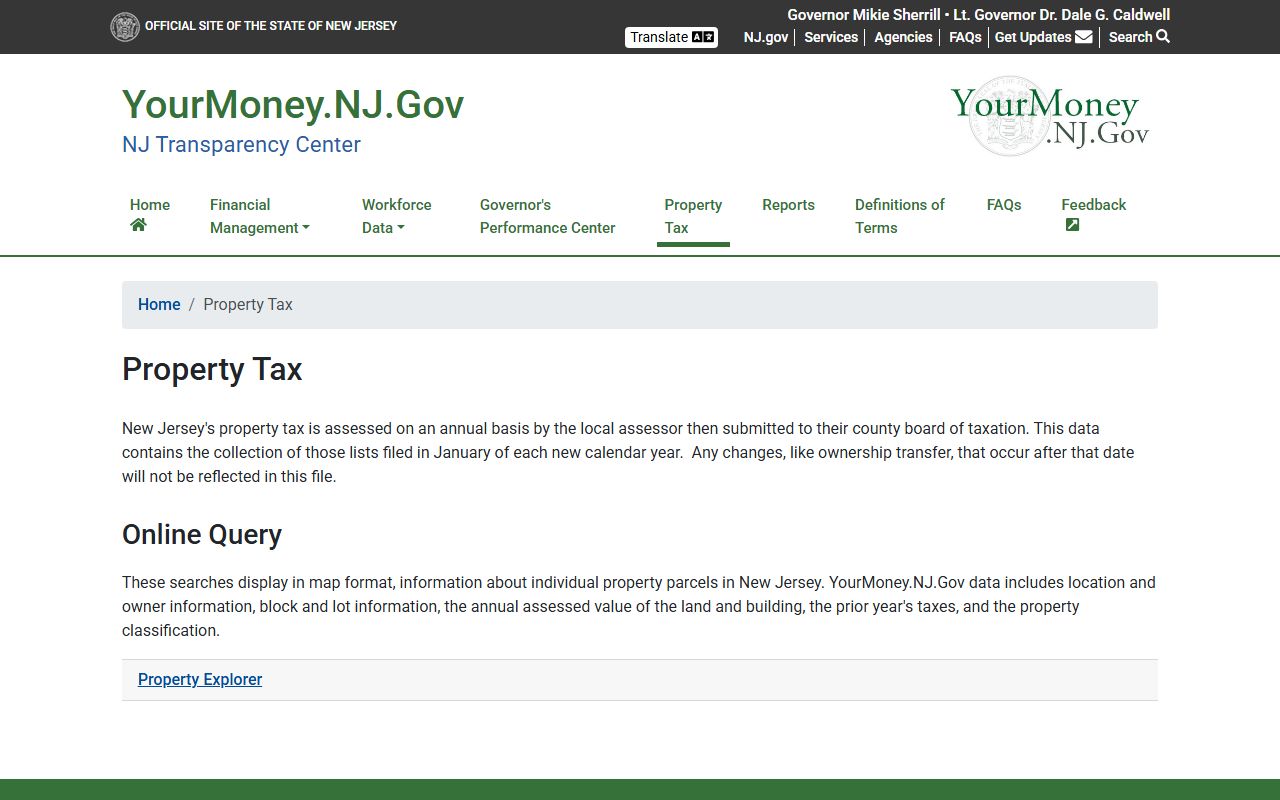
The State of New Jersey also offers the Property Tax Explorer at YourMoney.NJ.gov. This tool provides interactive maps and data for Newark and every other municipality in the state. You can compare tax rates, view historical trends, and see how Newark ranks among peer cities. The explorer draws on data reported by local assessors under N.J.S.A. 54:4-34, which requires annual filing of tax lists with county boards.
A third option is TaxRecords-NJ.com, which aggregates public property data from across the state. It can be helpful for quick lookups when you need basic ownership or valuation data for a Newark parcel.
Note: Online records may lag behind recent transactions. For the most current data, contact the Newark Tax Assessor's Office directly.
Property Tax Appeals in Newark
Newark property owners who believe their assessment is wrong may file an appeal with the Essex County Board of Taxation. The deadline is April 1 at 4:00 PM each year, as set by N.J.S.A. 54:3-21. The appeal form asks for the property's location, current assessed value, and the value the owner believes is correct. Supporting evidence such as recent sales, appraisals, or comparable properties strengthens the case. The board holds hearings and issues decisions that become part of the property's tax record in Newark.
Properties assessed at more than $1,000,000 may bypass the county board and file directly with the Tax Court of New Jersey. This path is governed by N.J.S.A. 54:3-21, which grants the Tax Court original jurisdiction over high-value appeals. Many commercial and industrial parcels in Newark fall into this category given the city's large commercial corridor and port-adjacent land. Tax Court filings carry their own procedures and deadlines.
A successful appeal results in a revised assessment. The county board or Tax Court issues a judgment that adjusts the assessed value. The city then recalculates the tax owed for that year. Refunds or credits may apply if taxes were already paid at the higher amount. All appeal outcomes are reflected in the property tax records maintained by both the city and the Essex County Board of Taxation.
Newark Tax Maps
Tax maps for Newark are maintained by Essex County. These maps show every parcel in the city with its block and lot designation. They are used by the Tax Assessor's Office to identify properties and track ownership changes. Under N.J.S.A. 54:1-59, the Director of the Division of Taxation sets standards for tax maps statewide. Newark's maps follow these standards and are updated as parcels are subdivided, merged, or reclassified.
You can obtain tax maps through the Essex County Tax Board website or by visiting county offices. The maps are public records. They are useful for title searches, boundary questions, and understanding how parcels relate to one another in a given block. Developers and attorneys working in Newark rely on these maps regularly.
Requesting Property Tax Records
Newark residents and the public can request property tax records through the Open Public Records Act (OPRA). N.J.S.A. 47:1A-1 et seq. grants the right to access government records, including assessment records, tax bills, ownership information, and related documents. The City of Newark processes OPRA requests through its online OPRA portal. You submit a form describing the records you need, and the city responds within seven business days as required by law.
OPRA requests are a good fit when you need specific documents that are not available through online search tools. For example, you might request copies of a property's full assessment history, internal correspondence about a valuation change, or records related to a tax lien. The city may charge a reasonable fee for copies as allowed under N.J.S.A. 47:1A-5.
Keep in mind that some records may be exempt from disclosure. Deliberative or advisory materials, attorney-client communications, and certain personnel records are not subject to OPRA. But most property tax records in Newark are public and available on request.
Delinquent Taxes and Tax Sales
When Newark property owners fail to pay their taxes, the city places a lien on the property. Under N.J.S.A. 54:5-19, municipalities must sell tax liens at an annual tax sale. The lien gives the buyer the right to collect the unpaid taxes plus interest. If the owner does not redeem the lien within a set period, the lien holder may begin foreclosure proceedings.
The Essex County Sheriff conducts foreclosure sales for delinquent Newark properties that reach the final stage. Listings of properties scheduled for sheriff's sale are published in advance and posted on the Essex County Sheriff's website. These listings include the property address, outstanding amount, and sale date. Investors and prospective buyers monitor these sales for opportunities in Newark's real estate market.
Note: Tax sale records become part of the property's permanent tax history and appear in title searches.
Newark Property Tax Deductions
New Jersey law provides several property tax deductions for eligible Newark residents. These deductions reduce the amount of tax owed each year and are applied directly to the property's tax bill. Applications are filed with the Newark Tax Assessor's Office. Each deduction has its own eligibility rules set by state statute.
- Senior citizen deduction of $250 under N.J.S.A. 54:4-8.40, available to residents age 65 or older who meet income limits
- Veteran deduction of $250 under N.J.S.A. 54:4-8.10, for honorably discharged veterans who are Newark residents
- Disabled person deduction of $250 under N.J.S.A. 54:4-8.40, for residents receiving Social Security disability benefits
- 100% disabled veteran full exemption under N.J.S.A. 54:4-3.30, which eliminates the entire property tax obligation
To claim a deduction, the property must be the owner's principal residence. The Tax Assessor's Office reviews each application and verifies eligibility. Once granted, the deduction continues each year as long as the owner remains eligible. Changes in ownership, residency, or status require a new application. These deductions appear in the property tax records as line items on the annual tax bill.
State Property Tax Resources
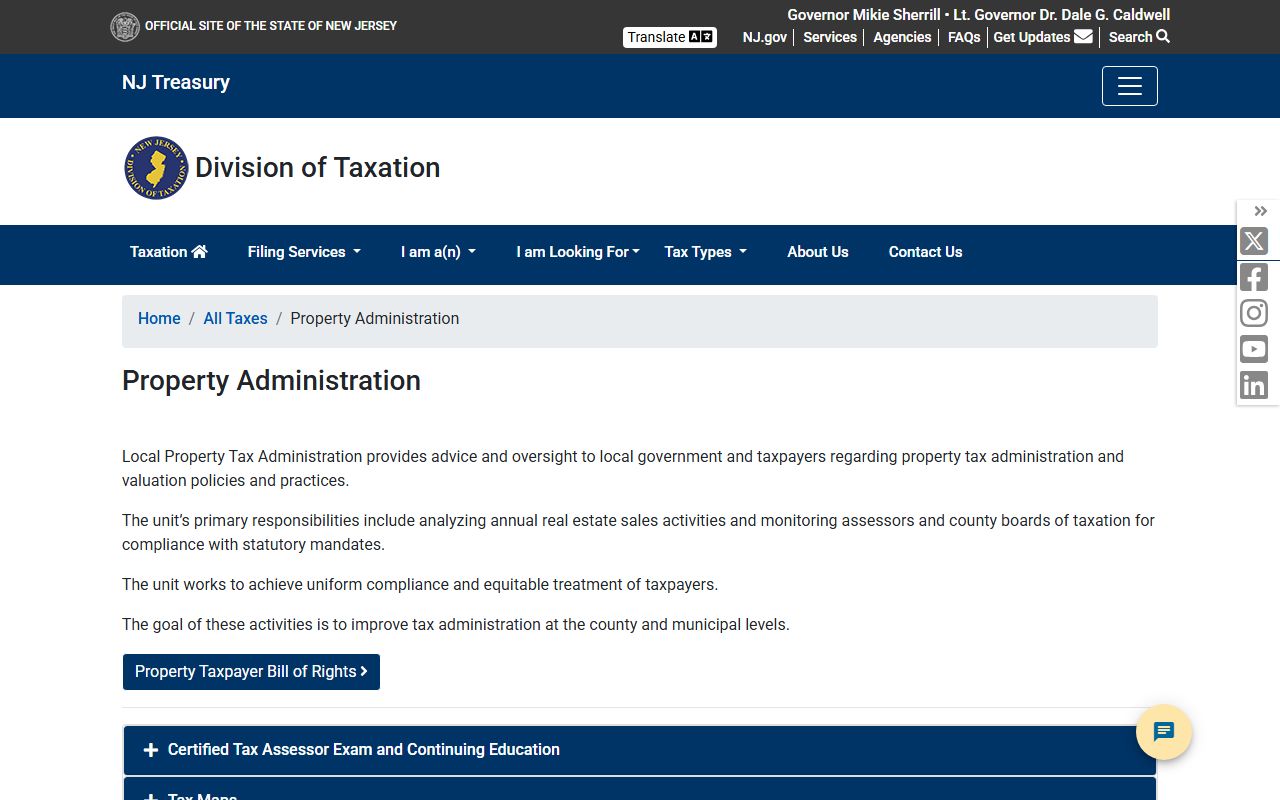
The New Jersey Division of Taxation within the Department of the Treasury oversees the local property tax system statewide. It sets standards for assessments, certifies county tax boards, and publishes data that includes Newark. The division's website provides access to equalization tables, tax rate information, and guidance documents that apply to all property tax records in the state.
Newark's property tax records exist within this broader state framework. The local assessor values each property. The Essex County Board of Taxation reviews and equalizes those values. The state division then uses the county data to calculate equalization ratios under N.J.S.A. 54:1-35.1. These ratios affect school aid, county tax apportionment, and other funding formulas. Understanding the state layer helps put Newark's local records in context.
Essex County Property Tax Records
Newark is the county seat of Essex County, and all property assessments are filed with the Essex County Board of Taxation. The county board handles appeals, maintains tax maps, and publishes assessment data for all 22 municipalities in the county. For more on countywide property tax records, assessment data, and related resources, visit the Essex County page.