
Essex County Tax Assessment Records
Essex County property tax records cover all 22 municipalities in one of the most densely populated areas of New Jersey. The Essex County Board of Taxation oversees local assessments and hears tax appeals from property owners across the county. Each town has its own tax assessor who values real property and sets the local tax rate. Property owners can search records, review past bills, and file appeals through the county board. Newark serves as the county seat and hosts the main tax board offices at the Dr. Martin Luther King Jr. Justice Complex.
Essex County Quick Facts
Essex County Board of Taxation
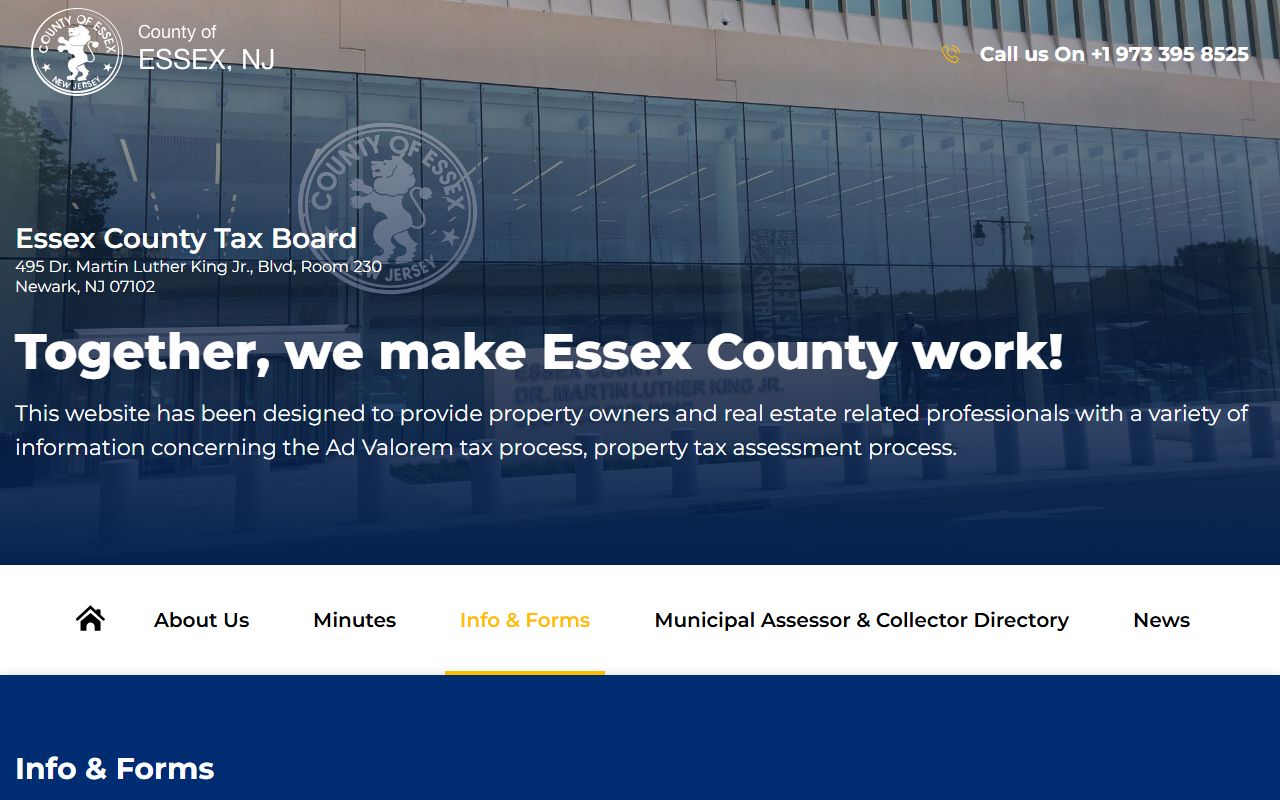
The Essex County Board of Taxation operates from the Dr. Martin Luther King Jr. Justice Complex at 495 Dr. MLK Jr. Blvd, Room 230, Newark, NJ 07102. You can reach them by phone at 973-395-8525. The board hears tax appeals, certifies assessment rolls, and ensures that all 22 municipalities apply fair and uniform property valuations. Under N.J.S.A. 54:3-21, any taxpayer who disagrees with their assessment may file an appeal with this board.
Tax appeal deadlines in Essex County are strict. The standard deadline is April 1 each year, or 45 days from the date the assessment notice was mailed, whichever is later. If a municipality completes a revaluation, the deadline shifts to May 1. The board reviews each case and can raise, lower, or affirm the assessed value. All decisions must rest on credible evidence of the property's true market value.

| Office |
Essex County Board of Taxation 495 Dr. MLK Jr. Blvd, Room 230 Newark, NJ 07102 Phone: (973) 395-8525 |
|---|---|
| Appeal Deadline | April 1 (May 1 in revaluation years) |
| Website | essexcountynjtaxboard.org |
Property Assessment Records Search
Assessment records for all 22 Essex County municipalities are available through online search tools. You can look up any parcel by owner name, block, lot, or street address. Each record shows the assessed land value, improvement value, total assessment, and the tax class. The records also list the property's qualification code and any deductions or exemptions that apply.
Per N.J.S.A. 54:4-23, every municipal assessor must prepare an annual assessment list that values all taxable real property in the district. This list becomes the basis for each year's tax bills. In Essex County, the average annual tax bill is roughly $13,615, which places it among the highest in the state. High property values in towns like Millburn, Montclair, and Short Hills drive much of this figure.
The NJ Property Tax transparency portal lets you compare tax records across all Essex County towns. It shows total levies, average assessments, and equalization ratios for each municipality.
Note: Assessment data may lag by several months. For the most current figures, contact your local assessor directly.
Essex County Tax Forms
The Essex County Board of Taxation provides all forms needed for appeals, deductions, and property tax filings on their information and forms page. These include the Petition of Appeal (Form A-1), which is the standard form for challenging your assessment. The AA-1 form is used when an assessor or taxing district initiates the appeal. Other forms cover senior citizen and disabled person deductions, veteran deductions, and farmland assessment applications.
Under N.J.S.A. 54:4-3.30, qualified senior citizens and disabled persons may receive a $250 annual property tax deduction. Veterans who served during wartime are also eligible for a $250 deduction under N.J.S.A. 54:4-3.15. These deductions must be filed with the local tax assessor, not the county board. Each town in Essex County processes its own deduction applications.
Real estate filings, certificates of occupancy records, and land records requests are also handled through the forms portal. If you need to record a deed or search for a prior filing, the county clerk's office can help with those records as well.
GIS Maps and Parcel Data
Essex County tax maps show property boundaries, lot dimensions, block and lot numbers, and zoning designations for every parcel in the county. These maps are used by assessors to identify and value real property as required under N.J.S.A. 54:4-26. Tax maps must be kept current and reflect all subdivisions, mergers, and boundary changes.
The county's GIS parcel viewer is built on the ArcGIS platform. It lets you zoom in on any property, view aerial imagery, and pull up ownership and assessment details. You can also overlay zoning maps, flood zones, and municipal boundaries. This tool is useful for property buyers, real estate agents, and anyone who needs to confirm lot lines or check what zone a property sits in.

Each municipal assessor is responsible for maintaining local tax maps. When a property is subdivided or merged, the assessor updates the map and assigns new block and lot numbers. The county board reviews these changes as part of its oversight role.
Note: GIS data is for reference only. It should not be used as a substitute for a professional survey.
Filing a Property Tax Appeal
Property owners in Essex County may challenge their assessment if they believe the assessed value exceeds the true market value of their property. The appeal is filed with the Essex County Board of Taxation on Form A-1. You can obtain this form from the board's website or office. The filing deadline is April 1, or May 1 in a revaluation year. There is no fee for filing an appeal with the county board.
Under N.J.S.A. 54:3-21, the taxpayer must demonstrate that the assessment is unreasonable. Evidence typically includes recent comparable sales, an independent appraisal, or proof of property defects that reduce value. The board schedules a hearing where both the taxpayer and the municipal assessor present their cases. The board may affirm, reduce, or increase the assessment based on the evidence.
If the assessed value exceeds $1,000,000, the appeal goes directly to the New Jersey Tax Court instead of the county board. Property owners dissatisfied with the county board's decision may also appeal to the Tax Court within 45 days of the board's judgment. The NJ Division of Taxation appeal guide provides detailed instructions for both the county board and Tax Court processes.
Municipal Tax Assessor Responsibilities
Each of Essex County's 22 municipalities employs a tax assessor who works under the direction of the Director of the Division of Taxation and the County Board. Per N.J.S.A. 54:3-16, the assessor must locate, identify, and value all real property within the district. This includes preparing the annual assessment list, maintaining tax maps, processing new deeds, and monitoring sales ratios to keep assessments in line with market values.
Assessors also review applications for tax deductions and exemptions. Common programs include the senior citizen deduction, the veteran deduction, the Homestead Rebate, and the Senior Freeze program. Chapter 75 postcards, which notify property owners of their new assessments, are typically mailed at the end of January. These postcards trigger the window for filing an appeal if the owner disagrees with the value.
Property owners can visit their local assessor's office to review the property record card for their home. This card shows the assessment breakdown, building dimensions, lot size, year built, and comparable properties used to set the value. Assessors in towns like Belleville and Nutley maintain public hours for walk-in visits.
Sheriff Sales and Tax Foreclosures
The Essex County Sheriff's Office conducts foreclosure sales for properties with delinquent taxes and mortgage defaults. These sales are held at scheduled auction dates and are open to the public. The sheriff's website posts current listings with property details, sale dates, and conditions of sale.
Tax sale certificates are issued when a property owner fails to pay their property taxes. Under N.J.S.A. 54:5-19, municipalities may sell these certificates at an annual tax sale. The certificate holder earns interest on the delinquent amount. If the taxes remain unpaid, the certificate holder may eventually foreclose on the property. Essex County municipalities conduct these sales at different times throughout the year.
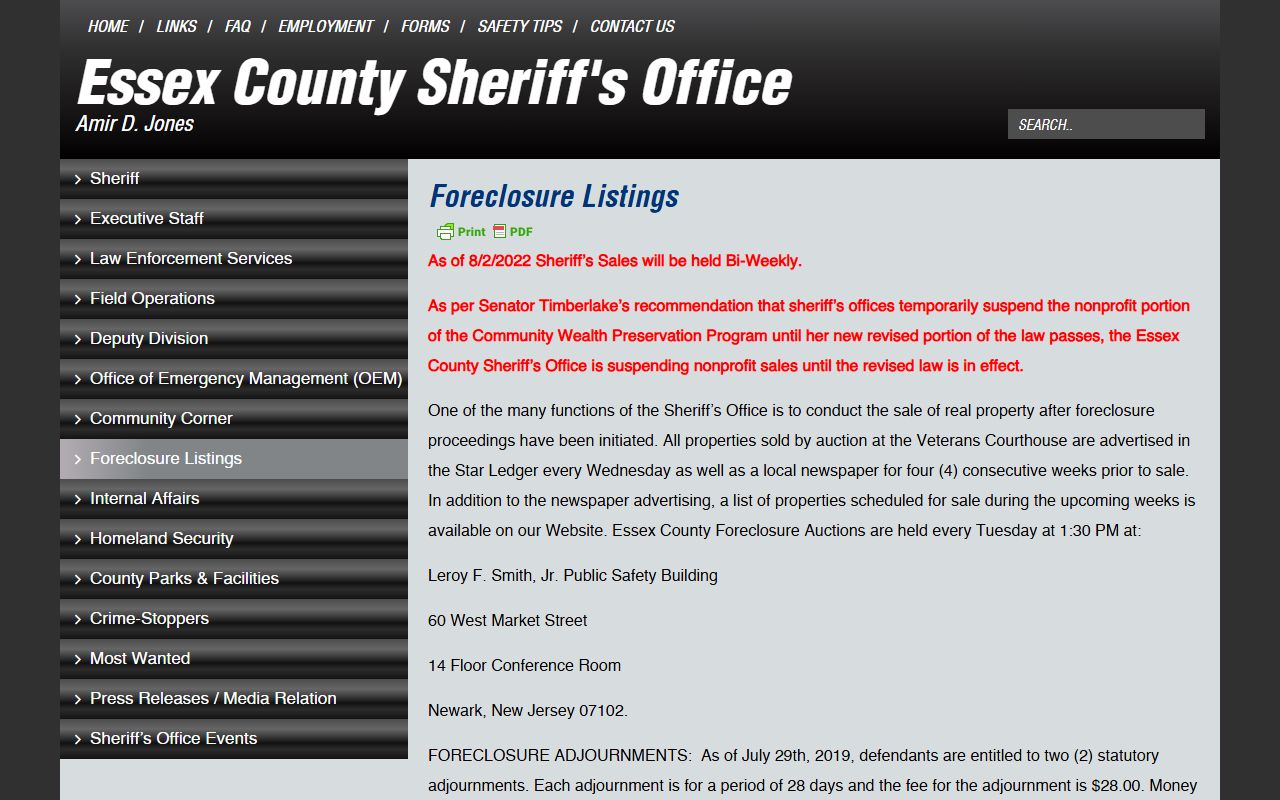
Bidders should review all conditions of sale before taking part in a sheriff's auction. A deposit is required at the time of sale, and the full balance is due within a set period. Title searches and property inspections are the buyer's responsibility. The sheriff's office does not guarantee clear title or property condition.
Tax Relief Programs in Essex County
New Jersey offers several property tax relief programs that apply to Essex County residents. These programs help reduce the tax burden for qualifying homeowners. Eligibility depends on age, income, disability status, or veteran status. Applications are filed with the local municipal assessor or directly with the state.
- Senior citizen and disabled person $250 deduction under N.J.S.A. 54:4-3.30
- Veteran $250 deduction under N.J.S.A. 54:4-3.15
- Homestead Rebate for qualifying homeowners
- Senior Freeze program that locks the tax amount for eligible seniors
- NJ SAVER rebate for qualifying property tax payers
The Senior Freeze program, also called the Property Tax Reimbursement program, reimburses eligible senior citizens and disabled persons for property tax increases. To qualify, you must meet age and income requirements and have lived in your home for at least three years. The NJ Division of Taxation local property tax page has full details on each program, including current income limits and application forms.
Revaluation and Equalization
The Director of the Division of Taxation may order a municipality to conduct a complete revaluation of all real property when assessments fall too far out of line with market values. This process involves inspecting every property in the town and assigning new assessed values based on current conditions and sales data. In Essex County, several municipalities have undergone revaluations in recent years to bring their ratios closer to 100 percent.
The county board also applies equalization tables each year. These tables adjust for differences in assessment ratios among the 22 municipalities so that each town pays its fair share of the county tax levy. Under N.J.S.A. 54:3-18, the county board must equalize the aggregate valuations of the taxing districts. This process ensures that a town assessing at 80 percent of market value does not pay less than a town assessing at 100 percent.
Note: After a revaluation, the appeal deadline extends to May 1 for that tax year. Property owners should watch for the updated Chapter 75 notices, which will reflect the new values.
Cities in Essex County
Essex County includes 22 municipalities, each with its own tax assessor and local tax office. Property tax records for any town can be searched through the county board or the individual municipal assessor. Below are some of the largest cities and townships in the county.
Other municipalities include Montclair, Livingston, West Orange, Maplewood, South Orange, Nutley, Belleville, Millburn, Glen Ridge, Caldwell, North Caldwell, Roseland, Fairfield, Cedar Grove, Verona, and Essex Fells. All file their assessment lists with the Essex County Board of Taxation.
Nearby Counties
These counties border Essex County. Property tax rates and assessment practices vary by county. If you own property near a county line, confirm which municipality and county your parcel falls in before filing any tax documents.