
Union County Property Tax Search
Union County sits in northeastern New Jersey and spans 21 municipalities with a combined population of more than 575,000 residents. The Union County Board of Taxation certifies all local assessment rolls and handles property tax appeals for the entire county. Elizabeth serves as the county seat. Each municipality sets its own tax rate based on local budgets, school levies, and the county tax portion. Property owners can search records online, review annual tax rates, and access land documents through county and state portals.
Union County Quick Facts
Union County Board of Taxation
The Union County Board of Taxation oversees property assessments across all 21 municipalities. This board certifies each town's assessment list, publishes annual tax rate data, and applies equalization tables that balance valuation differences among districts. Under N.J.S.A. 54:3-18, the county board must equalize the aggregate assessed values so that every municipality pays a fair share of the county tax levy. The board offices are located at the Union County courthouse complex in Elizabeth.
Property tax appeals are filed with this board. The standard filing deadline is April 1 of each tax year, or 45 days from the date the assessment notice was mailed, whichever is later. In years when a municipality completes a revaluation, the deadline extends to May 1. The board schedules hearings where property owners and assessors present evidence. Decisions are based on whether the assessed value reflects true market value as required by N.J.S.A. 54:4-1.
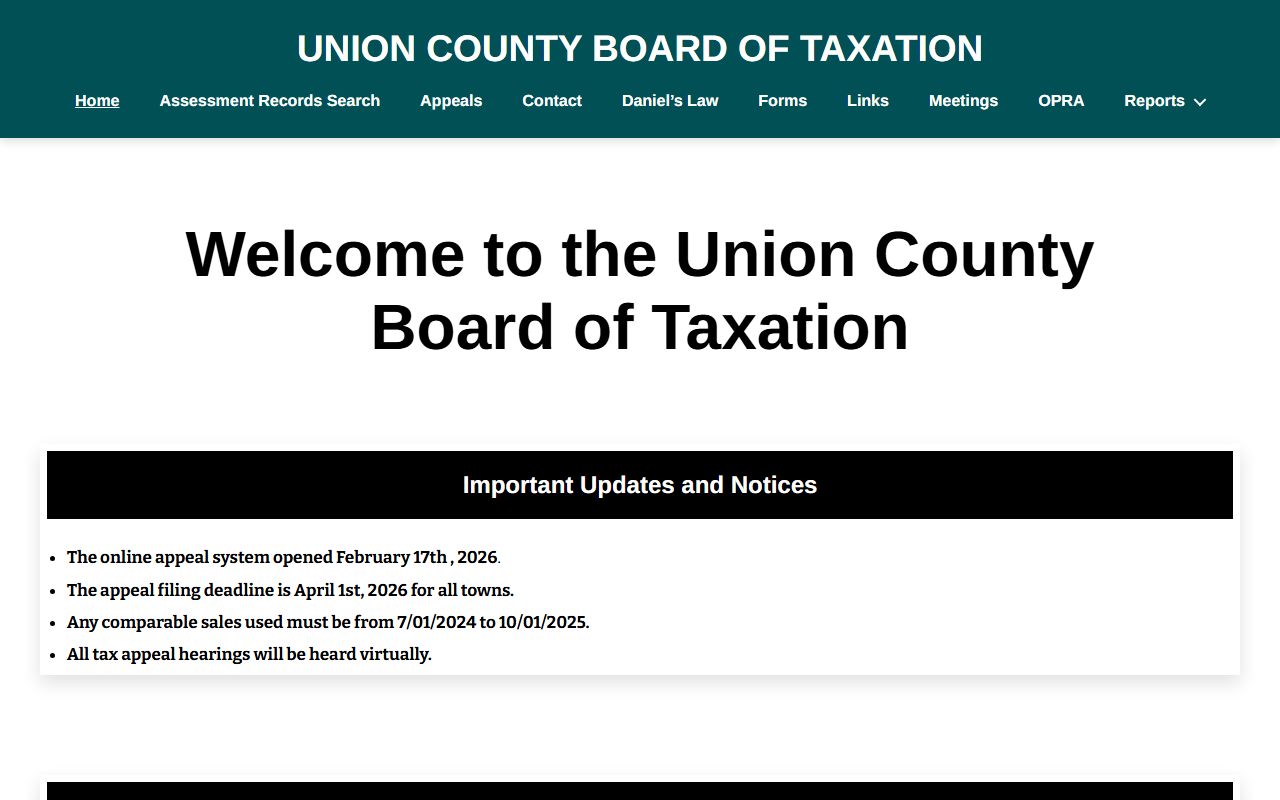
The board also publishes annual tax rates for all 21 municipalities. These rates break down into the municipal, county, school, and total tax portions. Residents can use this data to compare rates across towns.
| Office |
Union County Board of Taxation Union County Courthouse Elizabeth, NJ 07207 |
|---|---|
| Appeal Deadline | April 1 (May 1 in revaluation years) |
| Website | ucnj.org/board-of-taxation |
Union County Assessment Records
Assessment records for Union County properties are accessible through the taxrecords-nj.com portal. Select Union County and the specific municipality to look up parcels by owner name, block and lot number, or street address. Each record displays the assessed land value, improvement value, total assessment, property class, and any deductions that apply.
Under N.J.S.A. 54:4-23, every municipal tax assessor must prepare an annual assessment list that values all taxable real property at its full and fair value. The assessor files this list with the Union County Board of Taxation for certification. The board reviews the data, checks for errors, and confirms that the ratios fall within acceptable ranges. If a town's ratio drifts too far from the standard, the state Director of Taxation may order a reassessment or revaluation.
The New Jersey Property Tax transparency portal also includes Union County data. This state tool shows average assessments, total levies, and equalization ratios for each municipality. It is a good starting point for comparing tax burdens across towns.
Note: Online records may not reflect the most recent changes. For current figures, contact the local tax assessor in the municipality where the property is located.
Land Records at the County Clerk
The Union County Clerk's Office maintains land records for all 21 municipalities. This office records deeds, mortgages, liens, and other instruments that affect real property title. An online document search tool is available through the clerk's website, allowing users to look up recorded documents by name, address, or document type.
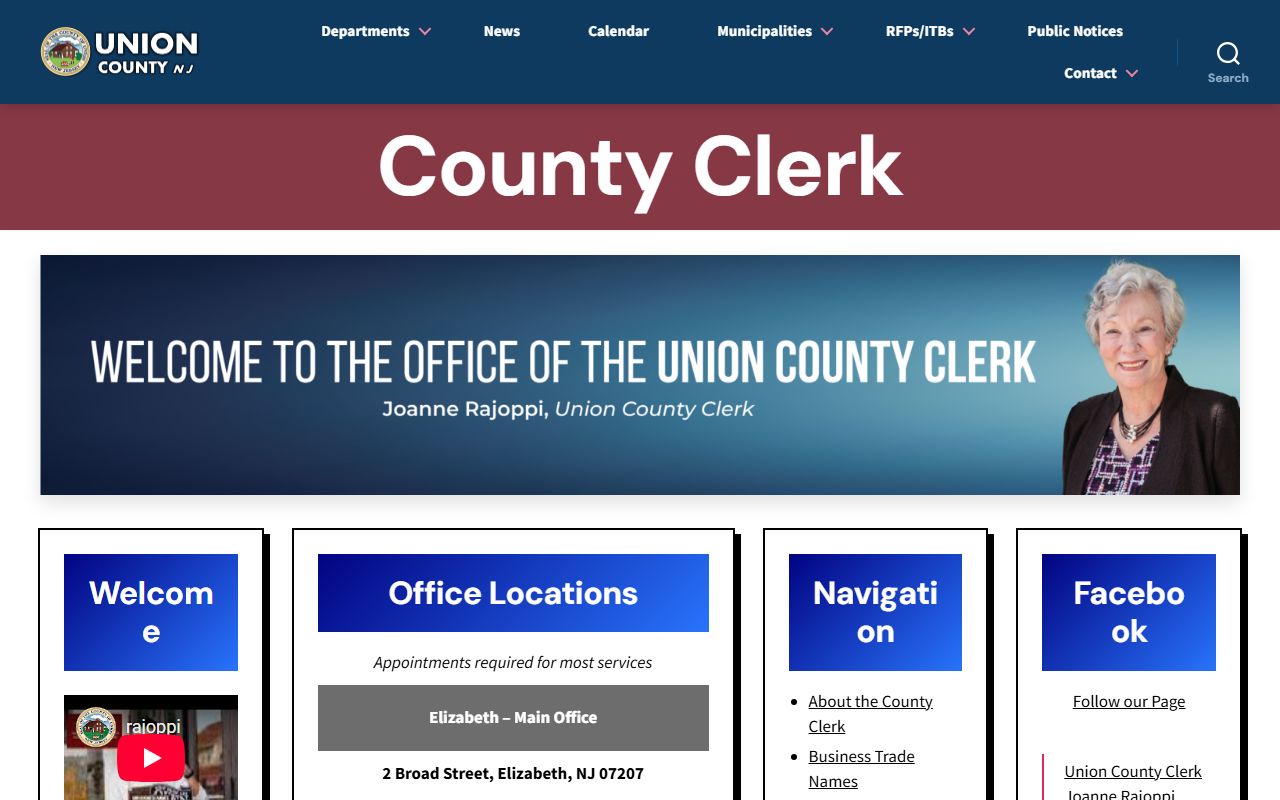
Recording a deed requires payment of a filing fee plus the state realty transfer fee. Under N.J.S.A. 46:15-7, the seller pays the realty transfer fee at the time of recording. The fee amount depends on the sale price and applies to most residential and commercial transactions. Exemptions exist for certain transfers, such as those between family members or as part of a divorce settlement. The clerk's office can confirm the exact fees and requirements before you submit documents.
Land record searches are public under the Open Public Records Act (OPRA). Anyone may request copies of recorded documents by visiting the office in person or through the online portal. Response times vary based on the volume of requests.
Tax Maps for Union County
Tax maps show block and lot boundaries for every parcel in Union County. Assessors rely on these maps to identify properties and track changes from subdivisions, mergers, or boundary line adjustments. N.J.S.A. 54:4-26 requires that each municipality maintain current tax maps that reflect the true dimensions and location of all taxable parcels.
Copies of tax maps are available at the Union County offices and through individual municipal assessors. Some towns post digital versions on their websites. These maps display lot lines, street frontage, acreage, and block and lot numbers used in assessment records. They are essential reference tools for title companies, surveyors, and attorneys who work with real property in the county.
When a property is subdivided, the municipal assessor assigns new block and lot numbers and updates the tax map. The county board reviews these changes as part of its annual certification process. Buyers should verify that the tax map matches the legal description in their deed.
Note: Tax maps are for assessment purposes only. They do not replace a licensed survey.
Filing Property Tax Appeals
Any Union County property owner who believes their assessment exceeds fair market value may file an appeal with the Board of Taxation. Appeals are filed on Form A-1, which is available from the New Jersey Division of Taxation or the county board's office. The filing deadline is April 1, or May 1 if the municipality underwent a revaluation that year.
The taxpayer must provide evidence that the assessed value is unreasonable. Comparable sales data is the most common form of proof. An independent appraisal or documentation of property defects can also support the case. Under N.J.S.A. 54:3-21, the burden of proof rests with the person challenging the assessment. The board may affirm, lower, or raise the value based on the evidence presented at the hearing.
Properties assessed at more than $750,000 must be appealed directly to the New Jersey Tax Court under P.L. 2017, c.128. Property owners who disagree with the county board's decision on lower-value properties may also appeal to the Tax Court within 45 days. The NJ Division of Taxation appeal guide explains both processes in detail.
Municipal Assessor Duties
Each of Union County's 21 municipalities employs a tax assessor who values all real property in the district. Per N.J.S.A. 54:3-16, the assessor must locate, identify, and assess every taxable parcel at 100 percent of true value. This work includes maintaining property record cards, processing new deeds, and monitoring sales activity to keep assessments current.
Assessors also handle applications for tax deductions and exemptions. Qualified senior citizens and disabled persons may receive a $250 annual deduction under N.J.S.A. 54:4-3.30. Veterans who served during wartime qualify for a $250 deduction under N.J.S.A. 54:4-3.15. These applications are filed with the local assessor's office, not the county board.
Chapter 75 postcards notify property owners of their current assessed value each January. This notice marks the start of the appeal window. If you disagree with the value on your postcard, you have until April 1 to file a formal appeal. Local assessors can explain how they arrived at your property's assessed value and what records they used.
Tax Rates and Equalization Data
Union County publishes annual tax rate data for all 21 municipalities through the Board of Taxation. Each town's rate reflects four components: the municipal portion, the county portion, the local school levy, and the total general tax rate. Rates vary widely across the county depending on local spending, school budgets, and the total rateable base.
Equalization is the process by which the county board adjusts for differences in assessment ratios among municipalities. Under N.J.S.A. 54:3-18, the board applies equalization tables so that each town's share of the county levy is based on the true value of its real property, not just the assessed value. A town that assesses at 85 percent of market value and a town that assesses at 100 percent will each pay a proportional share once equalization is applied.
- Municipal tax portion funds local government operations and services
- County tax portion supports Union County government and shared services
- School tax portion funds the local school district budget
- Open space tax funds county parkland and preservation efforts
The NJ Division of Taxation local property tax page provides statewide rate tables that include Union County data. Property owners can use these tables to compare their town's rate with neighboring municipalities.
Property Tax Relief Programs
Several state programs help Union County homeowners reduce their tax burden. Eligibility depends on factors such as age, income, disability status, and veteran status. Applications are filed either with the local municipal assessor or directly with the state.
The Senior Freeze program reimburses eligible senior citizens and disabled persons for property tax increases above their base year amount. To qualify, applicants must meet income limits and must have lived in their home for at least three consecutive years. The Homestead Rebate provides a direct payment to qualifying homeowners based on income and property tax paid.
- Senior citizen and disabled person $250 deduction (N.J.S.A. 54:4-3.30)
- Veteran $250 deduction (N.J.S.A. 54:4-3.15)
- Senior Freeze property tax reimbursement program
- Homestead Rebate for qualifying homeowners
Note: Income limits and program details change periodically. Check the NJ Division of Taxation website for the most current eligibility requirements.
Cities in Union County
Union County includes 21 municipalities, each with its own tax assessor and local tax office. Property tax records for any town can be searched through the county board or the individual municipal assessor. Below are some of the largest cities and townships in the county.
Other municipalities include Westfield, Scotch Plains, Cranford, Summit, Rahway, Linden, Roselle, Roselle Park, Clark, Kenilworth, Garwood, New Providence, Berkeley Heights, Mountainside, Springfield, Fanwood, Winfield, and Hillside. All file their assessment lists with the Union County Board of Taxation.
Nearby Counties
These counties border Union County. Property tax rates and assessment practices vary by county. If you own property near a county line, confirm which municipality and county your parcel falls in before filing any tax documents.