
Middlesex County Property Tax Information
Middlesex County ranks among the most populous counties in New Jersey, with 25 municipalities spread across central New Jersey. The Middlesex County Board of Taxation manages assessment oversight and hears property tax appeals for all districts in the county. Each municipality has a local tax assessor who values real property and maintains parcel records. Property owners can search records, review assessment cards, and challenge valuations through the county board. New Brunswick serves as the county seat and hosts the Board of Taxation at 75 Bayard Street.
Middlesex County Quick Facts
Middlesex County Board of Taxation
The Middlesex County Board of Taxation is at 75 Bayard Street, 4th Floor, New Brunswick, NJ 08901. You can call them at 732-745-3350. The board hears tax appeals, certifies local assessment rolls, and works to keep property valuations fair and uniform across all 25 municipalities. Under N.J.S.A. 54:3-21, any property owner who believes their assessed value is wrong may file an appeal with this board.
The standard appeal deadline is April 1 of each tax year. If a town has just gone through a revaluation, the deadline moves to May 1. The board reviews evidence from both the taxpayer and the local assessor before reaching a decision. It may raise, lower, or keep the current value. Properties with assessments above $1,000,000 may bypass the county board and file directly with the New Jersey Tax Court under N.J.S.A. 54:3-21.
| Office |
Middlesex County Board of Taxation 75 Bayard Street, 4th Floor New Brunswick, NJ 08901 Phone: (732) 745-3350 |
|---|---|
| Appeal Deadline | April 1 (May 1 in revaluation years) |
| Website | middlesexcountynj.gov |
Local Assessment Records in Middlesex
Every municipal tax assessor in Middlesex County maintains records that show how each parcel is valued. These records include owner name, mailing address, lot and block numbers, land value, improvement value, and total assessment. Building dimensions, lot size, and tax map data are also part of the file. Per N.J.S.A. 54:4-23, assessors must prepare an annual assessment list that covers all taxable real property in their district.
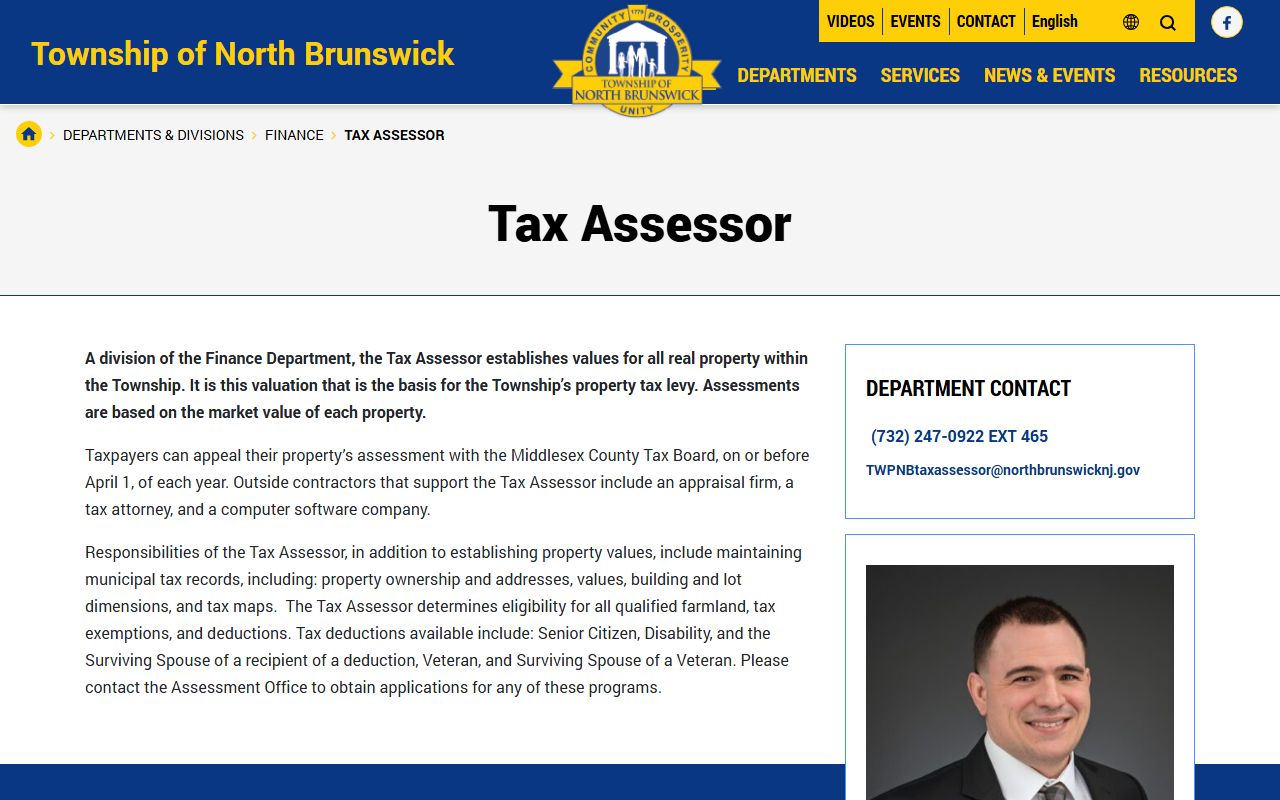
In North Brunswick, the Tax Assessor establishes values for all real property in the township. The valuation set by the assessor forms the basis for the tax levy. The office also tracks farmland assessment eligibility, tax exemptions, and deduction status for each parcel. Property owners can visit the assessor to review their property record card, which breaks down how the assessed value was reached. Assessment cards in Middlesex County are typically mailed by February 1, giving owners time to review them before the April 1 appeal deadline.
The NJ Property Tax transparency portal lets you compare assessment data across all 25 Middlesex County towns. It shows average assessments, total levies, and equalization ratios for each district.
Note: Online assessment data may not reflect the most recent changes. Check with your local assessor for up-to-date figures.
Middlesex County Tax Rates by Town
Property tax rates in Middlesex County vary from town to town. Each rate is set based on the total amount the municipality, school district, and county need to raise through property taxes. The rate is then applied to the assessed value of each parcel. Under N.J.S.A. 54:4-52, the local governing body certifies the tax rate after the county board approves the final assessment rolls.
For the 2024 tax year, effective rates across some of the largest Middlesex County municipalities were as follows: Edison at 2.086%, Woodbridge at 2.471%, East Brunswick at 2.400%, Piscataway at 1.801%, South Brunswick at 1.963%, Monroe at 1.617%, New Brunswick at 2.141%, Plainsboro at 2.302%, and North Brunswick at 2.544%. These rates produce a countywide average tax bill of roughly $9,400 per year. Towns with lower assessment ratios tend to show higher effective rates because the rate must compensate for the gap between assessed and market values.
Monroe Township has one of the lower rates in the county. Woodbridge and North Brunswick fall on the higher end. The rate alone does not tell you how much you will pay. Your bill depends on both the rate and your assessed value.
Assessment Appeals and Equalization
Property owners in Middlesex County who believe their assessment is too high can file an appeal with the county tax board. The appeal must be filed by April 1 on Form A-1. There is a filing fee that varies based on the assessed value. You will need to show that the assessed value does not reflect the true market value of your property as of October 1 of the pretax year. Comparable sales, an independent appraisal, or evidence of property defects are the most common forms of proof.
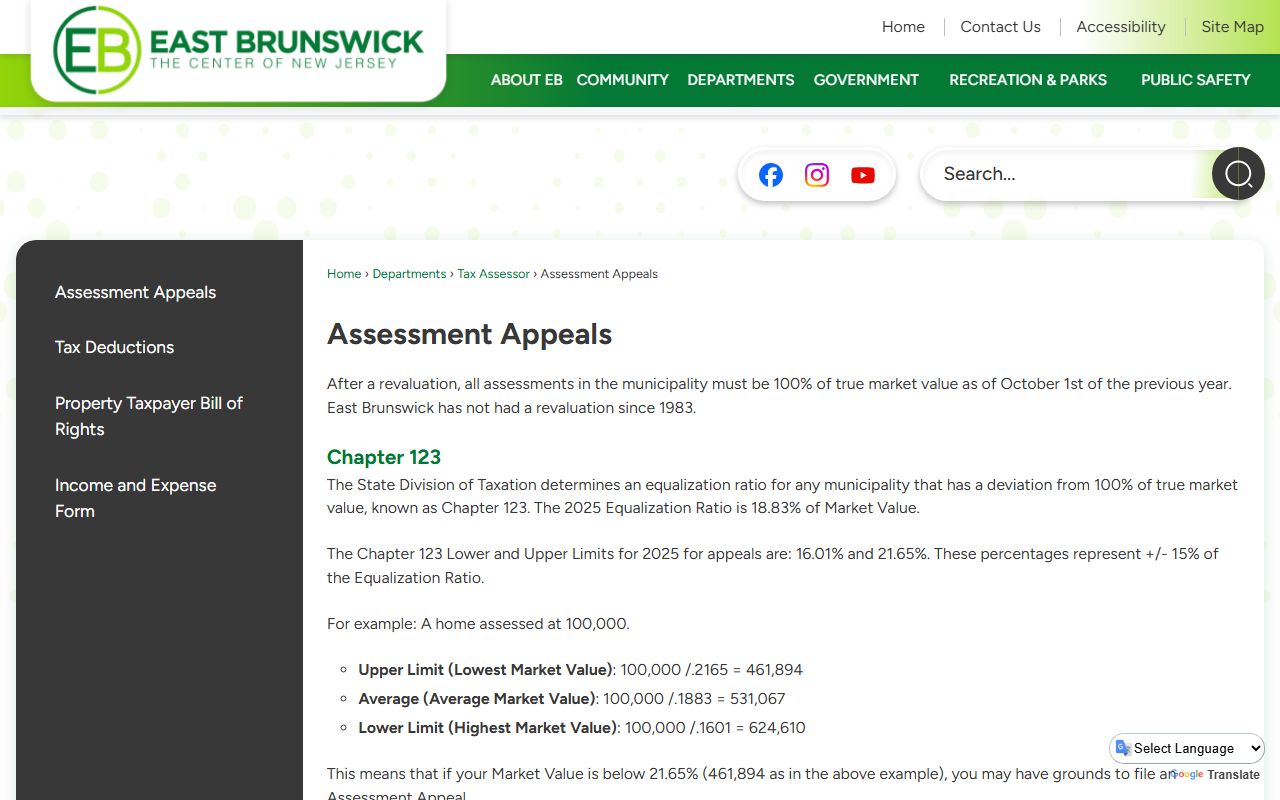
East Brunswick provides a clear example of how equalization works in practice. Under Chapter 123 of the property tax statutes, the State Division of Taxation determines an equalization ratio for each municipality. For 2025, East Brunswick's ratio is 18.83% of market value, with upper and lower limits of 21.65% and 16.01% respectively. This means a property assessed at $100,000 has an implied market value between roughly $461,894 and $624,610. If your property's market value falls outside that range, you may have grounds for an appeal.
Properties assessed above $1,000,000 may file directly with the New Jersey Tax Court rather than the county board. The NJ Division of Taxation local property tax page explains both the county board and Tax Court appeal processes in detail.
Note: The equalization ratio changes each year. Always check the current ratio before deciding whether to appeal.
Municipal Tax Assessor Duties
Each of the 25 municipalities in Middlesex County has a tax assessor who works under the direction of the NJ Division of Taxation and the Middlesex County Board of Taxation. Per N.J.S.A. 54:3-16, the assessor must locate, identify, and value all real property in the district. This work includes preparing the annual assessment list, updating tax maps when lots are split or merged, and processing deed transfers as they occur.
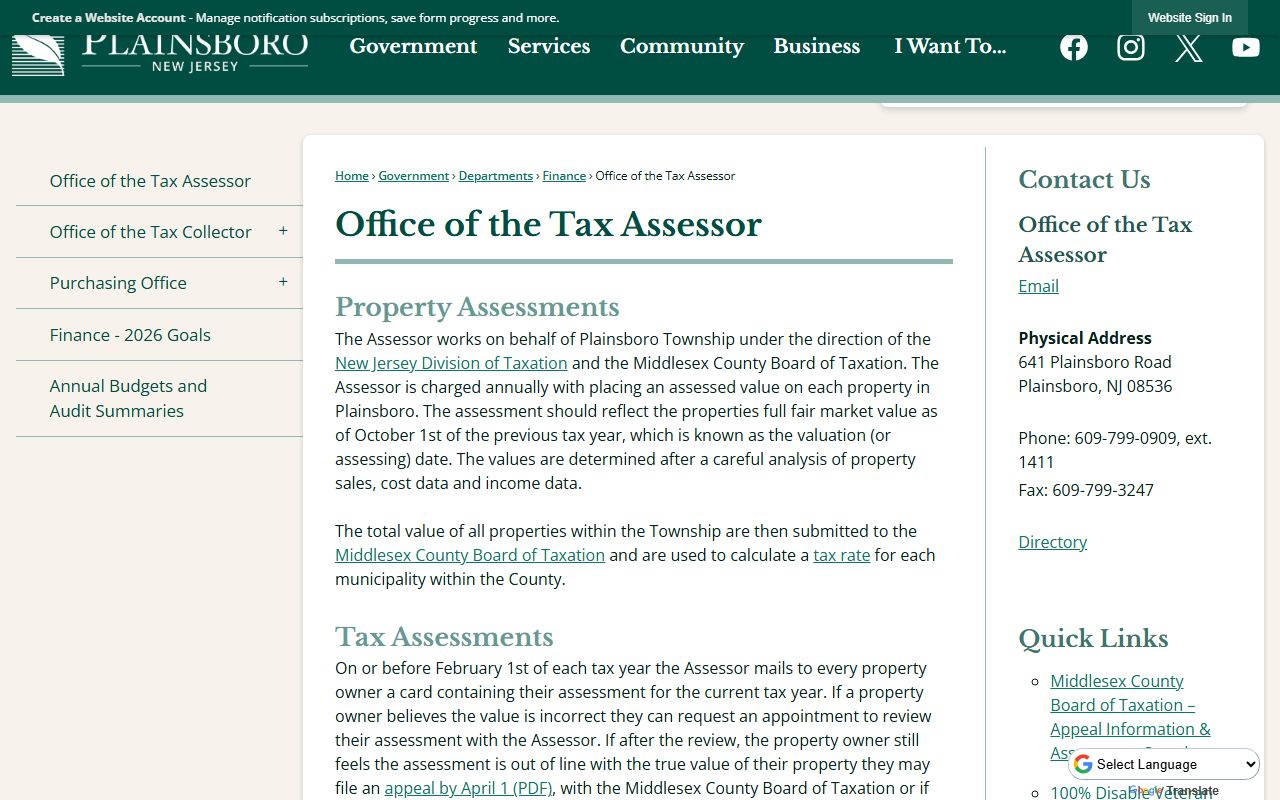
In Plainsboro Township, the tax assessor's office sets assessments that reflect full fair market value as of October 1 of the pretax year. Assessment cards are mailed by February 1, and owners have until April 1 to file an appeal with the Middlesex County Board of Taxation. The Plainsboro assessor also handles applications for deductions and exemptions, including the senior citizen, veteran, and surviving spouse deductions that are each worth $250 per year under N.J.S.A. 54:4-3.30 and N.J.S.A. 54:4-3.15.
Assessors also track property sales to make sure assessment ratios stay in line with the market. When the ratio drifts too far from 100%, the Division of Taxation may order a revaluation. This process requires the assessor to inspect every property in the municipality and assign new values based on current sales data.
Middlesex County Tax Payments
Property taxes in Middlesex County are due in four installments each year. The due dates are February 1, May 1, August 1, and November 1. Payments made by the 10th of the month are accepted without interest. After that date, interest accrues on the unpaid balance as allowed under N.J.S.A. 54:4-67.
Most Middlesex County towns accept payments by mail, in person, through a drop box, or online. Monroe Township, for example, also accepts phone payments at 866-572-9477. Online and phone payments may carry a processing charge. The NJ tax records portal provides links to individual municipal payment systems across the county.
If taxes go unpaid, the municipality will place a lien on the property. Under N.J.S.A. 54:5-19, the municipality may sell the tax lien at an annual tax sale. The buyer of the lien earns interest on the delinquent amount. If the owner still does not pay, the lien holder can eventually foreclose on the property. Middlesex County municipalities schedule their tax sales at different points during the year.
Tax Deductions and Relief Programs
Middlesex County residents may qualify for several property tax deduction and relief programs run by the state. Applications for most deductions are filed with the local tax assessor, not the county board. Eligibility depends on factors like age, income, veteran status, and disability.
- Senior citizen deduction of $250 per year under N.J.S.A. 54:4-3.30
- Disabled person deduction of $250 per year under N.J.S.A. 54:4-3.30
- Veteran deduction of $250 per year under N.J.S.A. 54:4-3.15
- Surviving spouse of a veteran deduction of $250
- Senior Freeze program that reimburses eligible seniors for tax increases
The Senior Freeze program, also known as the Property Tax Reimbursement program, locks in the tax amount for qualifying senior citizens and disabled persons. To be eligible, you must meet income and residency requirements and have lived in your home for at least three years. The North Brunswick Tax Assessor's office notes that surviving spouse deductions are also available for those who qualify. All deduction forms must be filed with the local assessor by the deadline set each year.
Revaluation and Reassessment
When a municipality's assessment ratio drifts too far from true market values, the Director of the Division of Taxation may order a revaluation. This requires the local assessor to inspect every property and assign a new value based on current market conditions. Several Middlesex County towns have gone through this process in recent years to bring their ratios closer to 100%.
A revaluation differs from a reassessment. A revaluation involves physical inspections of all properties and is typically conducted by an outside firm. A reassessment uses statistical methods to adjust values without visiting each property. Both aim to bring assessments in line with market values, but a revaluation is more thorough. Under N.J.S.A. 54:1-35.35, the tax assessor must certify that assessments reflect true value.
Cities in Middlesex County
Middlesex County includes 25 municipalities, each with its own tax assessor and local tax office. Property tax records for any town can be searched through the county board or the municipal assessor. Below are some of the largest cities and townships in the county.
Other municipalities include East Brunswick, South Brunswick, Monroe, Sayreville, North Brunswick, Plainsboro, Carteret, South Amboy, Metuchen, Highland Park, Cranbury, Spotswood, Helmetta, Dunellen, Milltown, South River, South Plainfield, and Middlesex Borough. All file their assessment lists with the Middlesex County Board of Taxation.
Nearby Counties
These counties border Middlesex County. Tax rates and assessment practices differ by county. If you own property near a county line, confirm which municipality and county your parcel falls in before filing any tax documents.