
New Brunswick Property Tax Assessment Records
New Brunswick property tax records reflect the county seat of Middlesex County, a city shaped by Rutgers University and a growing healthcare corridor. The city Tax Assessor values all real property within municipal borders and files an annual assessment list with the Middlesex County Board of Taxation. These records include assessed values, property classifications, ownership data, and block and lot numbers. Residents, investors, and researchers can search New Brunswick property tax data through city, county, and state resources to review current and historical valuation information.
New Brunswick Quick Facts
New Brunswick Assessed Values
The New Brunswick Tax Assessor determines the assessed value of every parcel in the city. Under N.J.S.A. 54:4-23, all real property must be assessed at its true value. The assessor examines sales data, building permits, physical inspections, and market trends to calculate each value. Land and improvements are valued separately, and the total appears on the property's assessment card. These cards are mailed to property owners by February 1 each year, giving them time to review the figures before the appeal deadline.
The 2024 effective tax rate in New Brunswick is 2.141%. This rate represents the actual tax burden as a percentage of a property's market value, accounting for the ratio between assessed values and true market values. The effective rate is a useful tool for comparing New Brunswick to other Middlesex County towns, since each municipality may assess properties at a different ratio of true value. The New Brunswick Tax Assessor's Office can provide details on how the rate applies to specific parcels.
New Brunswick's tax base includes a mix of residential, commercial, and institutional properties. Rutgers University holds a significant amount of tax-exempt land within the city, which shifts a larger share of the tax burden onto remaining taxable properties. Under N.J.S.A. 54:4-3.6, state-owned educational facilities are exempt from local property taxes. This dynamic is a defining feature of the city's property tax records.
Searching New Brunswick Tax Records
The Middlesex County Board of Taxation maintains assessment data for all municipalities in the county. The board's office is on the 4th floor of 75 Bayard Street in New Brunswick, NJ 08901. You can reach them at 732-745-3350. As the county seat, New Brunswick is home to the very building where these records are stored and processed. Search options include owner name, property address, and block and lot number.
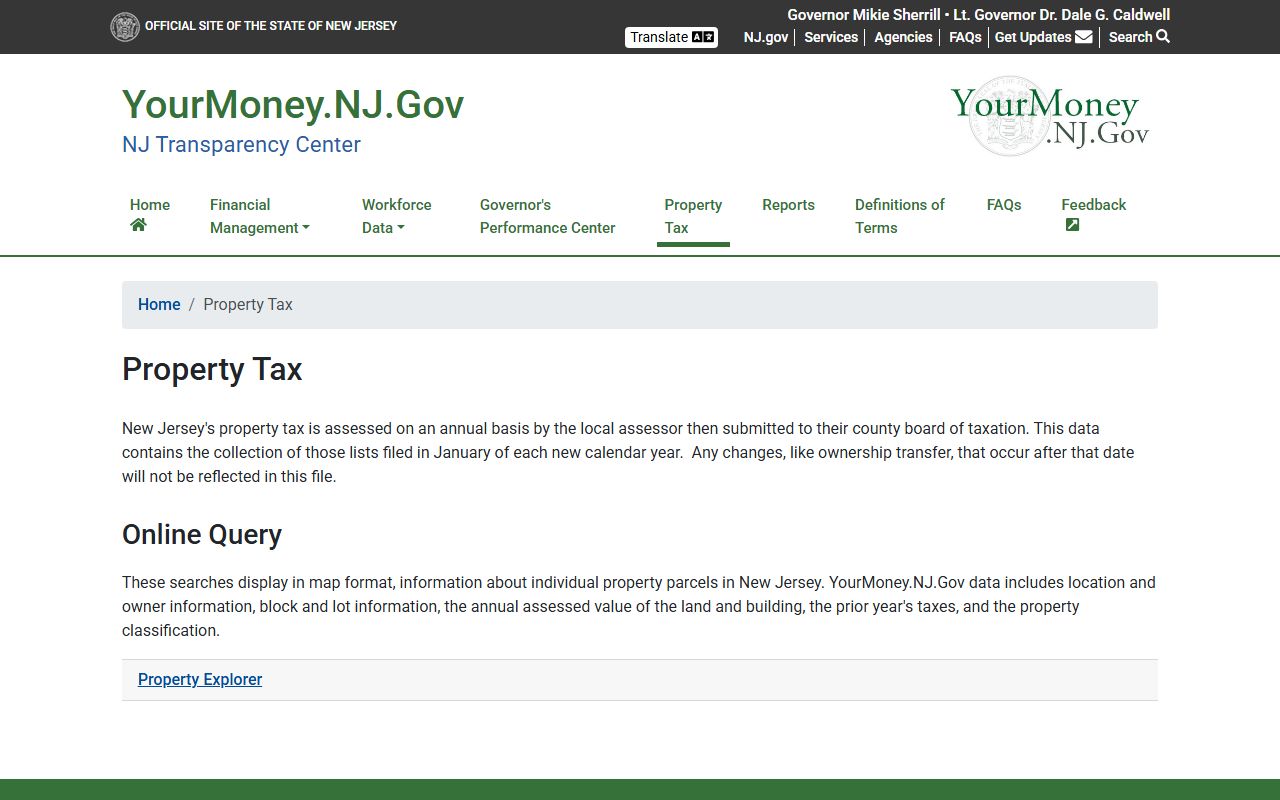
The Property Tax Explorer at YourMoney.NJ.gov provides state-level data for New Brunswick. You can view tax rates, compare municipalities across Middlesex County, and examine historical trends. The data is drawn from annual assessment lists filed under N.J.S.A. 54:4-34 and certified by the county board.
TaxRecords-NJ.com offers another way to search New Brunswick property data. The site compiles public records from across the state and lets you look up parcels by address or owner name. It is a quick option for basic valuation and ownership details.
Note: Online databases may lag behind recent sales or assessment changes. Contact the Tax Assessor's Office for the most current figures.
Chapter 123 Equalization Process
New Jersey uses a process called equalization to ensure fair distribution of county taxes among municipalities. Under Chapter 123 of the state statutes, the State Division of Taxation reviews assessed values in each town and calculates an equalization ratio. This ratio measures how closely a municipality's total assessed values match estimated true market values. For New Brunswick, the ratio determines the city's share of county-level taxes and affects how school aid is distributed.
The equalization process relies on accurate local assessments. When a municipality's ratio drifts too far from 100%, it may trigger a revaluation or reassessment. The New Jersey Division of Taxation publishes equalization tables annually. These tables show each municipality's ratio and aggregate true value. Property owners in New Brunswick can use this data to understand how their assessment compares to the broader market and how the city's tax share is calculated at the county level.
Property Tax Appeals in New Brunswick
Property owners in New Brunswick who believe their assessed value is too high may file an appeal with the Middlesex County Board of Taxation. The deadline is April 1 of the current tax year, as stated in N.J.S.A. 54:3-21. The appeal form requires the property's location, current assessment, and the value the owner contends is correct. There is a filing fee that varies based on the assessed value of the property. Supporting documents such as appraisals, comparable sales, and photographs strengthen the appeal.
The board holds hearings where both the property owner and the municipal assessor can present evidence. The board then issues a written judgment. If the appeal is successful, the assessed value is reduced and the tax bill is recalculated. Refunds or credits may apply if taxes were already paid at the original amount.
Properties assessed at more than $1,000,000 may bypass the county board and file directly with the Tax Court of New Jersey under N.J.S.A. 54:3-21. The Tax Court has original jurisdiction over these high-value appeals. Large commercial properties, apartment complexes, and mixed-use buildings in New Brunswick's downtown may fall into this category. The Tax Court has its own procedures, deadlines, and filing requirements.
New Brunswick Tax Maps and Parcels
Tax maps for New Brunswick are maintained by Middlesex County. Each map shows the block and lot layout for a section of the city. Under N.J.S.A. 54:1-59, the Director of the Division of Taxation sets standards for tax maps statewide. New Brunswick's maps follow these standards and are updated as properties are subdivided, merged, or reclassified. The maps are public records and are available through the county tax board office.
Tax maps serve multiple purposes. Title companies use them to confirm lot boundaries during real estate closings. Developers use them to identify parcels available for assembly. Attorneys reference them in zoning and land use matters. The maps also help the assessor track changes in property boundaries that may affect assessed values. For researchers studying New Brunswick property tax records, the tax map is a starting point for understanding how land is divided and classified.
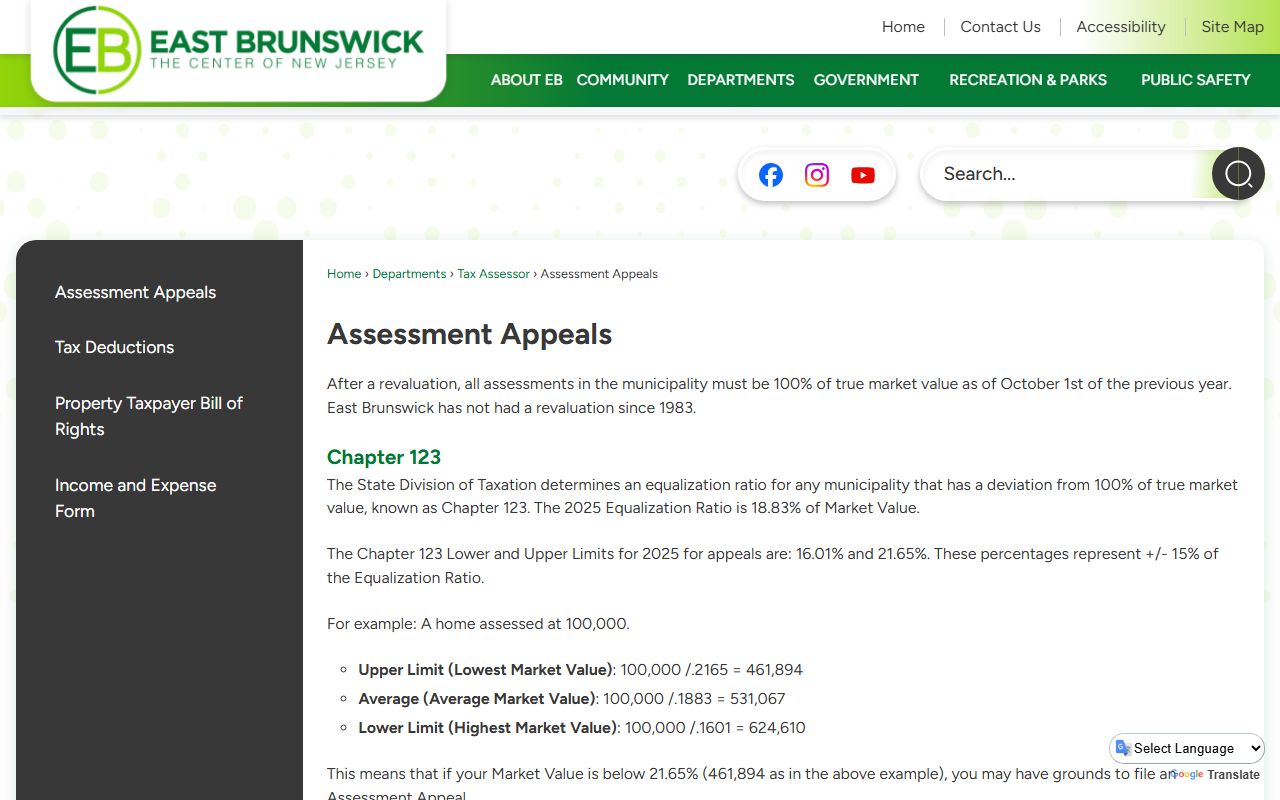
The East Brunswick assessment appeals page provides an example of how neighboring Middlesex County towns handle similar processes, offering useful context for New Brunswick property owners considering an appeal.
New Brunswick Property Tax Deductions
Eligible New Brunswick residents may apply for property tax deductions through the Tax Assessor's Office. These deductions are set by state law and reduce the taxable value by a fixed amount each year. The property must be the applicant's principal residence to qualify.
- Senior citizen deduction of $250 under N.J.S.A. 54:4-8.40 for residents age 65 or older meeting income requirements
- Veteran deduction of $250 under N.J.S.A. 54:4-8.10 for honorably discharged veterans who reside in New Brunswick
- Disabled person deduction of $250 under N.J.S.A. 54:4-8.40 for residents receiving Social Security disability
- Full exemption for 100% disabled veterans under N.J.S.A. 54:4-3.30, which eliminates the entire tax obligation
Deductions remain in effect each year as long as the owner stays eligible. A change in ownership, residency, or disability status requires a new application. Each deduction appears as a line item on the annual tax bill and is part of the property's permanent tax record in New Brunswick.
Public Records Requests
The Open Public Records Act at N.J.S.A. 47:1A-1 et seq. gives the public the right to access government records in New Brunswick. Property tax records, including assessment histories, tax bills, and lien data, fall under OPRA. Requests are submitted through the city clerk's office. The city must respond within seven business days under the statute. A reasonable copy fee may apply as permitted by N.J.S.A. 47:1A-5.
OPRA is particularly useful when you need documents not available through online databases. You might request the full assessment history for a specific parcel, internal notes on a valuation change, or records related to a tax lien sale. Most property tax records in New Brunswick are public and available upon request.
Middlesex County Property Tax Records
New Brunswick serves as the county seat of Middlesex County. All property assessments are filed with the Middlesex County Board of Taxation, which operates from the same city. The board handles appeals, maintains assessment rolls, and publishes data for all 25 municipalities in the county. For countywide property tax records, appeal procedures, and assessment resources, visit the Middlesex County page.