
Monmouth County Property Tax Search
Monmouth County maintains property tax records for 53 municipalities along the central New Jersey coast. The county Board of Taxation coordinates assessment oversight and hears appeals from property owners across the region. Each municipality employs its own tax assessor who values all real and personal property within the district. Residents can search records online, review assessment data, and access sales history through the county's public portals. Freehold serves as the county seat and houses the main tax board offices.
Monmouth County Quick Facts
Monmouth County Board of Taxation
The Monmouth County Board of Taxation oversees property assessments for all 53 municipalities in the county. The board certifies each town's annual assessment roll, conducts equalization studies, and hears tax appeal petitions from property owners. Under N.J.S.A. 54:3-21, any taxpayer who believes their assessed value does not reflect true market value may file a petition with the county board. The board uses the MOD IV assessment database to track parcel data, ownership records, and valuation figures across all districts.
Appeal deadlines follow a strict calendar. The standard filing date is April 1 at 4:00 PM. In years when a municipality completes a revaluation, that deadline shifts to May 1. Property owners must submit a completed A-1 Petition of Appeal along with comparable sales data that supports their claimed value. The board then schedules a hearing where both sides present evidence. Per N.J.S.A. 54:3-22, the board may raise, lower, or affirm the assessment based on the facts presented.
| Office |
Monmouth County Board of Taxation Freehold, NJ co.monmouth.nj.us |
|---|---|
| Appeal Deadline | April 1 at 4:00 PM (May 1 in revaluation years) |
| Appeal Forms | A-1 Petition of Appeal, Comparable Sales Form |
Property Assessment Records Online
Monmouth County provides free online access to property assessment records through its Property Records Search portal. This tool draws from the MOD IV database and covers every taxable parcel in the county's 53 municipalities. You can search by district or municipality, street location, owner name, block number, lot number, or qualifier. Each result displays the current owner, property address, assessed land and improvement values, total assessment, property classification code, and recent sales data.
Under N.J.S.A. 54:4-23, every municipal assessor must prepare an annual assessment list that values all taxable real property in the district. The MOD IV system stores these lists and makes them available to the public. Assessment records show how each parcel breaks down between land value and improvement value. They also indicate whether the property carries any deductions, exemptions, or added assessments for recent construction. This data is essential for buyers researching a property, owners preparing an appeal, or professionals conducting market analysis.
The NJ State Property Explorer also includes Monmouth County data with interactive maps that let you compare assessments, tax rates, and levy totals across all 53 municipalities.
Note: Online records may not reflect the most recent transfers or assessment changes. Contact the local assessor for the latest figures.
Sales Records and Ratio Studies
Real estate sales in Monmouth County are reported to the county Board of Taxation through SR1A forms. The SR1A Sales Search tool provides public access to this data. You can search by municipality, date range, and property type to find recorded transactions. Each entry shows the sale price, property location, buyer and seller names, deed date, and whether the sale was usable for ratio calculations.
The county board relies on SR1A data to conduct its annual assessment ratio studies, which measure how close each municipality's assessments are to actual market values. Under N.J.S.A. 54:1-35.1, the Director of the Division of Taxation publishes equalization tables based on these ratios. Towns with ratios far below 100 percent may be ordered to perform a reassessment or full revaluation. Comparable sales from the SR1A database also serve as key evidence in tax appeal hearings, where both property owners and assessors use recent transaction prices to argue for a fair assessed value.
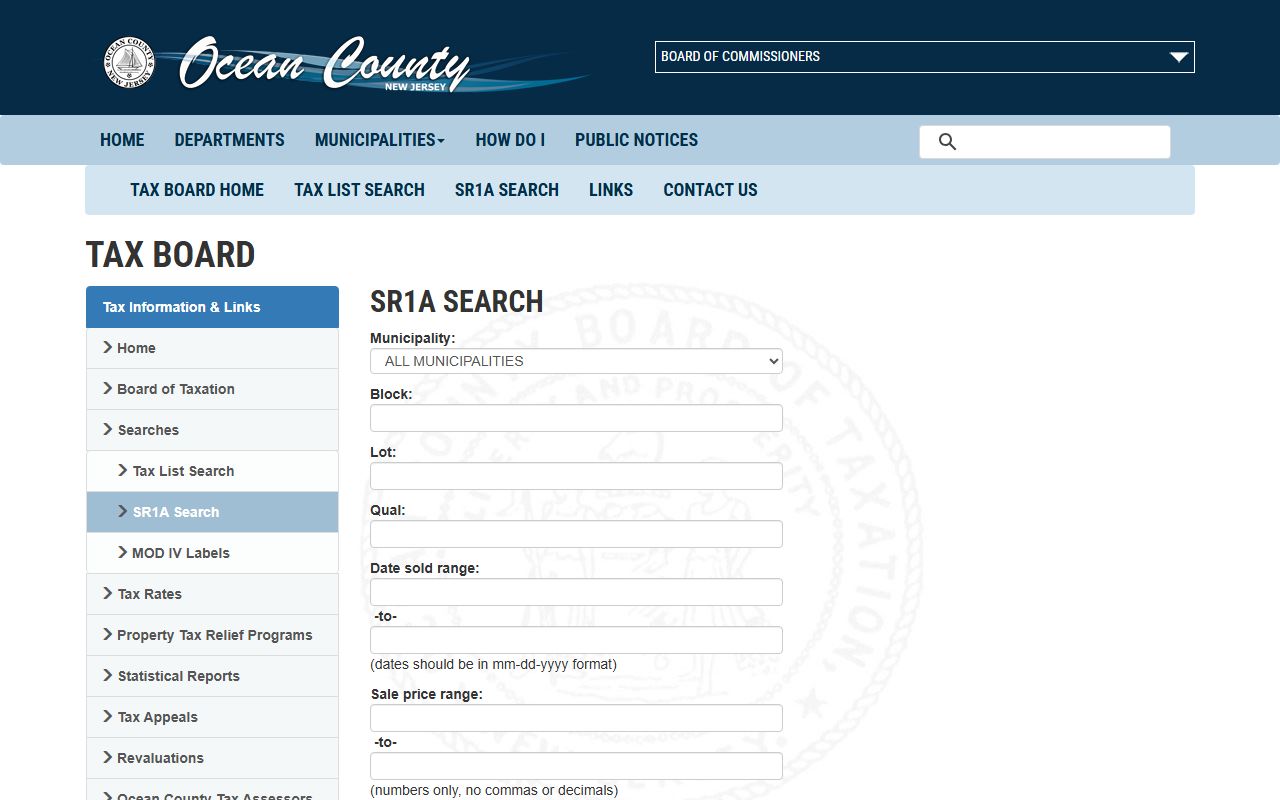
Sales data is useful for homeowners who want to check how their assessment compares to nearby transactions. It also helps real estate agents price listings and gives appraisers raw data for their reports. Keep in mind that not all sales qualify as arm's-length transactions. Family transfers, foreclosures, and short sales are flagged as non-usable in the ratio study.
Local Assessor Offices in Monmouth
Each of the 53 municipalities in Monmouth County has a tax assessor responsible for valuing all real and personal property within the district. Assessors prepare the annual assessment list, maintain tax maps, process new deeds, and review applications for deductions and exemptions. Per N.J.S.A. 54:3-16, the assessor must locate, identify, and value every taxable parcel.
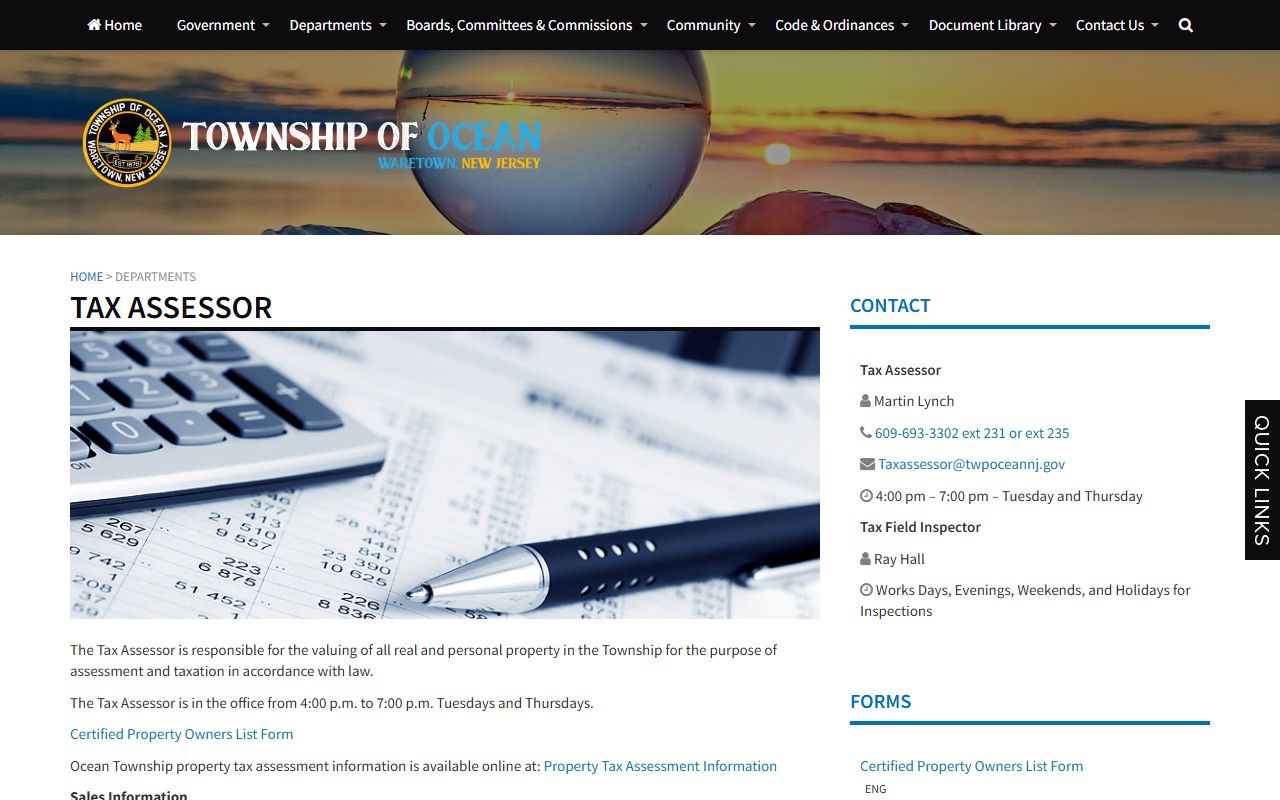
The Ocean Township Tax Assessor is one example of how local offices operate in Monmouth County. The office holds public hours on Tuesday and Thursday from 4:00 PM to 7:00 PM. Residents can visit to review their property record card, pick up an assessment postcard, check neighborhood sales, obtain a copy of their deed, review tax maps, or access GIS data. The office also handles address changes and assessment inquiries. For the 2025 tax year, Ocean Township's tax rate is $1.578 per $100 of assessed value, with an equalization ratio of 99.33 percent.
Chapter 75 postcards, which notify owners of their new assessments, are typically mailed at the end of January. These notices trigger the appeal window. If the assessed value on the postcard seems too high, the owner should gather comparable sales and contact the assessor before filing a formal petition.
Note: Office hours and services vary by municipality. Check your town's website for current schedules before visiting.
Monmouth County Tax Maps
Tax maps for all 53 Monmouth County municipalities show property boundaries, block and lot numbers, street names, and parcel dimensions. Under N.J.S.A. 54:4-26, every assessor must maintain accurate tax maps that reflect the current state of each parcel. When a lot is subdivided or merged, the assessor updates the map and assigns new block and lot designations. The county board reviews these changes during its annual certification process.
Property owners, title companies, and surveyors frequently use tax maps to confirm lot lines and identify adjacent parcels. The maps are available at local assessor offices and through the county's online portals. Some municipalities also offer GIS viewers that layer tax map data over aerial imagery, allowing users to see building footprints, wetlands, and zoning boundaries alongside the standard parcel grid.
Filing a Tax Appeal
Property owners in Monmouth County who believe their assessed value exceeds fair market value may file a tax appeal. The process begins with the A-1 Petition of Appeal, which must be submitted to the county Board of Taxation by the April 1 deadline at 4:00 PM. In revaluation years, the deadline extends to May 1. The petitioner should include a completed Comparable Sales form showing recent transactions that support a lower value.
Under N.J.S.A. 54:3-21, the burden of proof falls on the taxpayer. The board considers comparable sales, property condition, income data for commercial properties, and any other relevant evidence. Both the property owner and the municipal assessor may present testimony. The board can affirm, reduce, or increase the assessed value based on what the evidence shows.
If the total assessment exceeds $1,000,000, the appeal must be filed directly with the New Jersey Tax Court rather than the county board. Taxpayers who disagree with the county board's decision may appeal to the Tax Court within 45 days of the judgment. The NJ Division of Taxation local property tax page provides forms, instructions, and filing guidance for both venues.
Property Tax Relief Programs
Several state programs help Monmouth County homeowners reduce their property tax burden. Eligibility depends on age, income, disability status, or military service. All applications are filed with the local municipal assessor or directly with the state, not the county board.
- Senior citizen and disabled person $250 deduction under N.J.S.A. 54:4-3.30
- Veteran $250 deduction under N.J.S.A. 54:4-3.15
- Senior Freeze program that reimburses eligible seniors for tax increases
- ANCHOR property tax relief for qualifying homeowners
The Senior Freeze program, also called the Property Tax Reimbursement program, locks in a base-year tax amount for qualifying residents. To be eligible, applicants must meet age and income thresholds and have lived in their home for at least three years. The state reimburses the difference between the base-year amount and the current tax bill. Detailed income limits and application forms are posted on the NJ Division of Taxation website.
Revaluation and Equalization
When a municipality's assessment ratio drifts too far from 100 percent, the Director of the Division of Taxation may order a reassessment or full revaluation. This process involves a physical inspection of every property in the district and a fresh valuation based on current market conditions. Several Monmouth County towns have completed revaluations in recent years to bring their ratios in line with state standards.
The county board applies equalization tables each year to adjust for differences in assessment ratios among the 53 municipalities. Under N.J.S.A. 54:3-18, the board must equalize the aggregate valuations so that each district pays its fair share of the county tax levy. A town assessing at 75 percent of market value would otherwise shoulder less of the county burden than a town assessing at full value. The equalization process corrects this imbalance.
Note: After a revaluation, property owners receive new Chapter 75 notices reflecting updated values. The appeal deadline for that year extends to May 1.
Cities in Monmouth County
Monmouth County includes 53 municipalities, each with its own tax assessor and local tax office. Property tax records for any town can be searched through the county's online portal or the individual municipal assessor. Below are some of the largest communities in the county.
Other municipalities include Freehold Township, Manalapan, Marlboro, Holmdel, Colts Neck, Long Branch, Red Bank, Asbury Park, Neptune, Tinton Falls, Rumson, Fair Haven, Ocean Township, Aberdeen, Matawan, Keyport, Hazlet, and Wall Township. All 53 districts file their assessment lists with the Monmouth County Board of Taxation.
Nearby Counties
These counties border Monmouth County. Property tax rates and assessment practices differ from county to county. If you own property near a county line, verify which municipality and county your parcel falls under before filing tax documents or appeals.