
Burlington County Tax Assessment Records
Burlington County spans 819.8 square miles, making it the largest county by area in all of New Jersey. The county seat is Mount Holly. Forty municipalities fall under Burlington County's tax jurisdiction. The Board of Taxation certifies property records each year based on an October 1st valuation date. Property owners across the county can search assessment data, review tax maps, and access rate information through several public resources. Burlington County was officially incorporated on May 17, 1694, and has maintained land and tax records for centuries.
Burlington County Quick Facts
Burlington County Board of Taxation
The Board of Taxation is the central office for property tax records in Burlington County. It certifies assessments for all 40 municipalities each year. Under N.J.S.A. 54:4-1, New Jersey uses an ad valorem tax system. This means each property is taxed based on its full true value. The Board reviews data from local assessors and ensures the tax list is correct before it takes effect.
Burlington County adopted an alternate tax calendar in 2018, following the lead of Gloucester and Monmouth counties. Under this schedule, the preliminary tax list is struck on November 1st of the pre-tax year. Notices of Assessment are mailed out by November 15th. The final tax list is certified by May 5th. This gives property owners more time to review their values and file appeals if needed.
The Burlington County Board of Taxation website provides details on how assessments are certified and how to contact the office for questions about your property tax records.
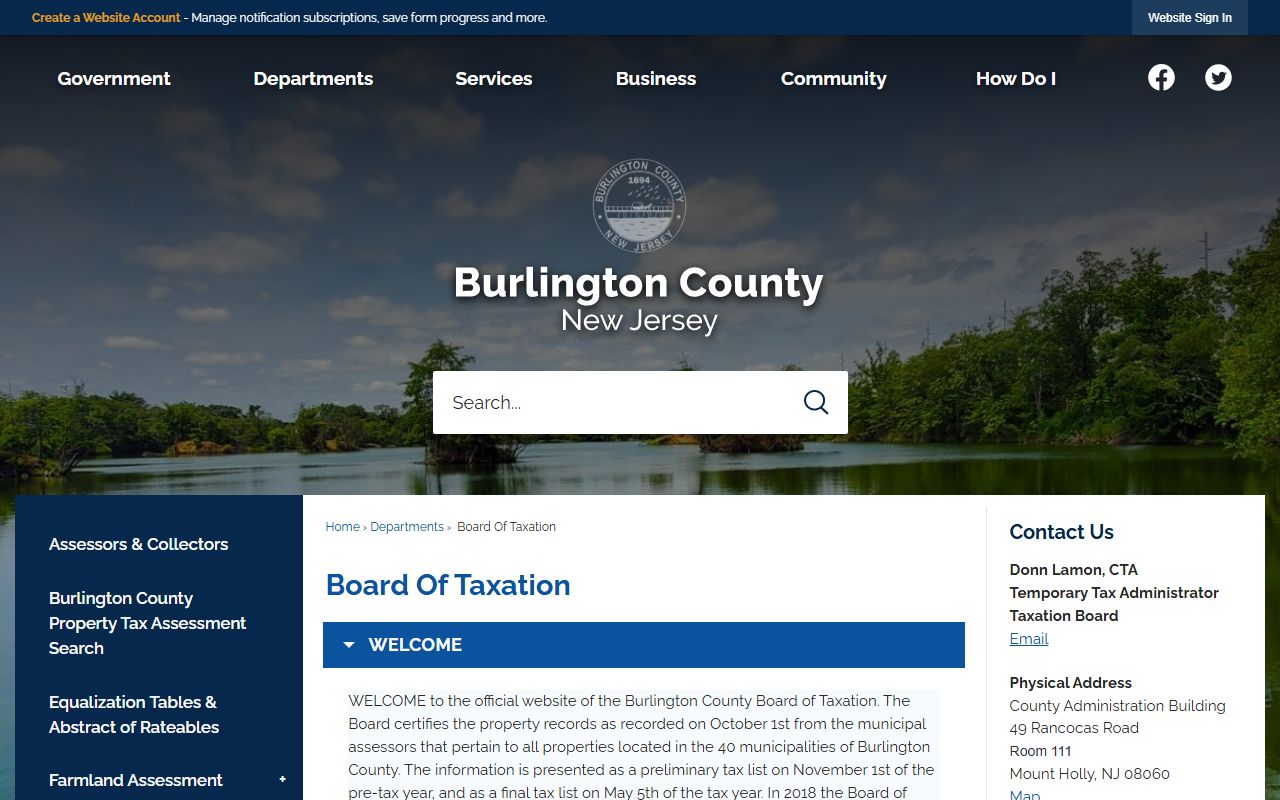
The Board office is located in Mount Holly. Staff can help with questions about your assessed value, the tax calendar, and the appeals process. You can also find forms and instructions at the Board's office or on the county website.
Property Tax Records Search
Burlington County offers an online tool for searching property assessment records. You can look up any parcel in the county's 40 municipalities by owner name, street address, or block and lot number. The search results show assessed values, owner information, recent sales data, and property class codes. This is a free public resource.
Each record includes the land value and improvement value that make up the total assessment. Sales history helps you see what a property last sold for and when. The property class tells you if the land is residential, commercial, farm, or another use. All of this information comes from the certified tax list maintained by the Board of Taxation under state law.
Note: Assessment data is updated each year after the Board certifies the tax list. If you need records from prior years, contact the municipal assessor in your town or file an OPRA request with the county.
Burlington County Tax Maps
Tax maps are a key part of the property record system. They show boundaries, block and lot numbers, street names, and lot dimensions for every parcel in the county. The Burlington County Tax Map Division maintains official maps for all 40 municipalities.
These maps help owners find their property, confirm lot lines, and verify that the assessor has the right data on file. They are also used by title companies, surveyors, and attorneys during real estate transactions. You can view or request copies of tax maps through the county's Tax Map Division.
Block and lot numbers are the backbone of the property tax system. Every parcel in Burlington County has a unique block and lot. This number links the tax map to the assessment record, the deed, and the tax bill. When you search for property tax records, the block and lot is the most precise way to find a specific parcel.
Tax Rates in Burlington County
Property tax rates in Burlington County vary by municipality. Each town's rate reflects its own budget plus its share of county and school taxes. The rate is expressed per $100 of assessed value. A home assessed at $200,000 in a town with a rate of $3.50 would owe $7,000 in annual property taxes. Rates change each year as budgets are adopted.
The general tax rate has several parts. The municipal portion pays for local services like roads, police, and parks. The county portion funds county government and shared services. The school portion covers the local school district budget. Some towns also have special district taxes for fire, library, or other purposes. Burlington County publishes annual rate tables that break down each component for all 40 municipalities.
New Jersey's Division of Taxation also publishes statewide rate data. You can compare Burlington County rates to other counties and track changes over time. The state requires that all property be assessed at 100% of true market value, though actual ratios may differ between revaluation years.
Note: If your town's ratio falls below a threshold set by the county, a revaluation or reassessment may be ordered to bring values in line with current market conditions.
Property Tax Appeals
Property owners in Burlington County have the right to challenge their assessment. The deadline to file is April 1st at 4:00 PM, or 45 days from the date of bulk mailing of assessment notices, whichever is later. Appeals go to the Burlington County Board of Taxation for properties assessed at $750,000 or less.
For properties assessed above $750,000, the appeal must be filed directly with the New Jersey Tax Court. The state's appeal guide explains the process and forms for Tax Court filings. Both avenues require the owner to show that the current assessment does not reflect fair market value as of October 1st.
Appeal forms are available online, at the Board of Taxation office in Mount Holly, and at municipal assessor offices across Burlington County. You will need to provide evidence of your property's value. Common evidence includes recent sales of comparable homes, an appraisal, or data showing errors in the property record. The Board hears appeals and issues decisions that can raise, lower, or keep the current value.
The Taxpayer Bill of Rights, enacted under P.L. 2017, c.128, gives property owners clear rights in the assessment and appeal process. It requires that assessment notices include the deadline and instructions for filing an appeal. Burlington County mails these notices each November under the alternate calendar.
Burlington County Clerk Land Records
The Burlington County Clerk maintains land records dating back to 1798. This office handles deed and mortgage recording, UCC filings, and trade name registrations. It is the official repository for documents that transfer or encumber real property in Burlington County.
Deeds and mortgages are closely tied to property tax records. When a property sells, the new deed is recorded with the County Clerk and the assessor updates the tax list. The sales price from the deed helps confirm the market value used in assessments. You can search recent land records online through the Clerk's office.
Older records require an in-person visit or an OPRA request. The County Clerk's office is in Mount Holly. Staff can help you locate deeds, mortgages, and other recorded documents for properties in Burlington County.
State Property Tax Records
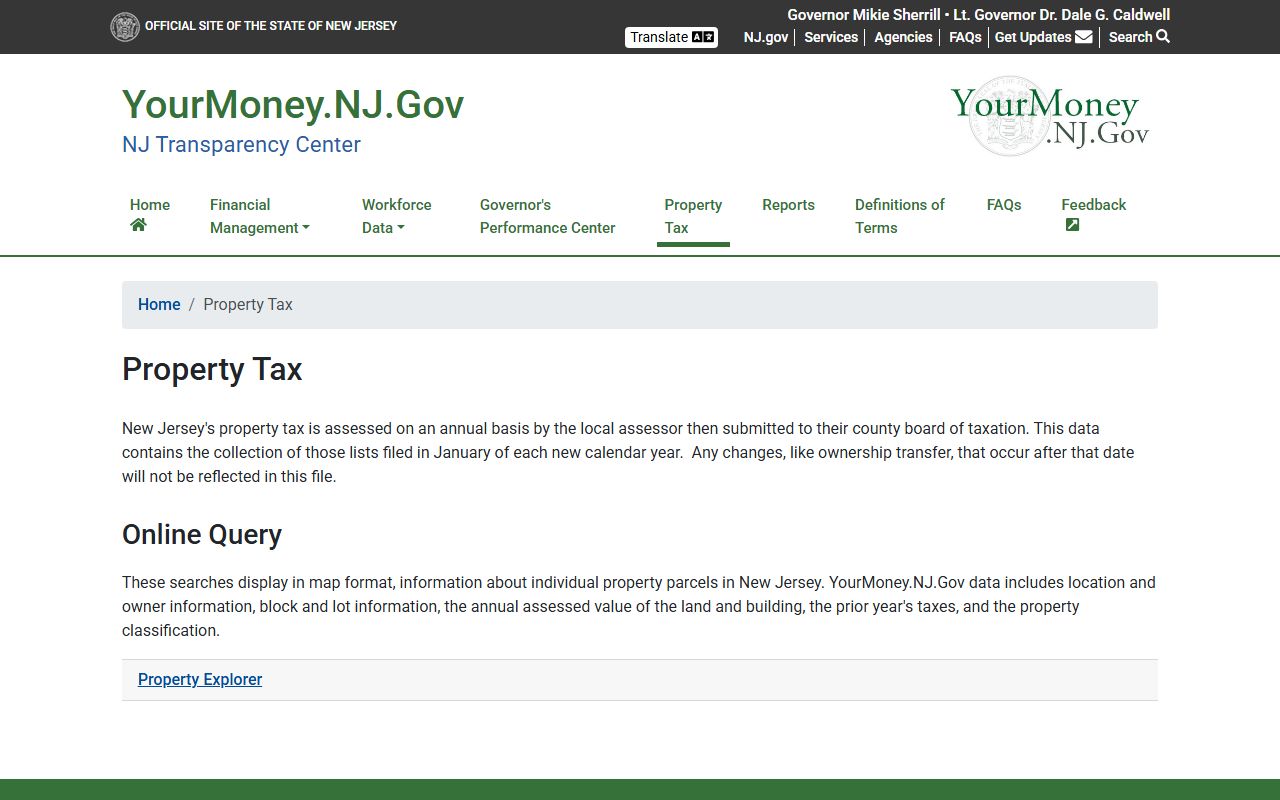
New Jersey provides a statewide property tax explorer that includes data for Burlington County. The YourMoney.NJ.gov Property Tax Explorer offers interactive maps and search tools. You can look up individual properties, compare tax rates across towns, and view historical assessment data.
The tool pulls from the same certified tax lists that Burlington County uses locally. It covers all 40 municipalities and lets you filter by town, property type, or value range. This is a useful way to see how Burlington County tax levels compare to the rest of the state.
The state also maintains resources on deductions, exemptions, and credits that can reduce your tax bill. Senior citizens, veterans, and disabled persons may qualify for deductions under various sections of N.J.S.A. 54:4. Check with your local tax collector or the Burlington County Board of Taxation to see what applies to your situation.
Public Records Requests
Burlington County handles public records requests under the Open Public Records Act, N.J.S.A. 47:1A-5. You can request property tax records, assessment data, tax maps, and other government documents through OPRA. Requests can be submitted online, by mail, or in person at the county's OPRA office.
The county must respond within seven business days. Most property tax records are readily available and can be provided quickly. There may be a small fee for copies. OPRA is a good option when you need historical records or documents not available through online search tools.
You can also request records directly from the municipality where the property is located. Each of the 40 towns in Burlington County has its own records custodian who handles OPRA requests for local documents like tax bills, collector records, and assessor files.
Tips for Burlington County Property Owners
Keeping track of your property tax records helps you stay informed and prepared. Here are a few steps worth taking:
- Review your Notice of Assessment each November when it arrives
- Compare your assessed value to recent sales in your area
- Check your property record card for errors in lot size, building area, or features
- Know the April 1st appeal deadline if you plan to file
- Keep copies of past tax bills and assessment notices for your records
Errors in property records are not uncommon. An extra bathroom, a wrong lot size, or an outdated building class can affect your assessed value. Contact your municipal assessor to correct mistakes. If the assessor does not fix the issue, you can raise it in a formal appeal to the Board of Taxation.
The TaxRecords-NJ.com site also provides access to property data across New Jersey counties, including Burlington. It can be a helpful starting point for basic lookups.
Nearby Counties
These counties border Burlington County. Property tax rates and assessment practices can vary from one county to the next. If you own property near a county line, confirm which jurisdiction your parcel falls under.