
Hudson County Tax Assessment Records
Hudson County sits on the west bank of the Hudson River and holds some of the most densely built land in New Jersey. The county contains 12 municipalities, with Jersey City serving as the county seat. Property tax records here cover more than 124,500 residential parcels and over 10,183 commercial properties. Each town in the county sets its own tax rate, but the county government publishes combined rate tables each year. Residents can search assessments, payment records, and ownership data through several online tools maintained at the county and municipal level.
Hudson County Quick Facts
Hudson County Property Records Online
The Hudson County Property Records Portal lets you look up tax data by address, owner name, or block and lot number. This tool pulls from the county tax rolls and shows assessed values, lot size, and ownership history. You do not need an account to run a search. The portal is free to use and works on phones and computers.
You can also search through taxrecords-nj.com, which covers all 12 Hudson County towns. Go to the site, click Records Search, pick Hudson County, and then choose the town you need. Enter a street address, owner name, or block and lot to pull up the record. Results show the assessed land value, the building value, and the total assessment. The site also lists the tax class and any deductions on file. Under N.J.S.A. 54:4-34, all real property in New Jersey must be assessed at true value, and these records reflect that mandate.
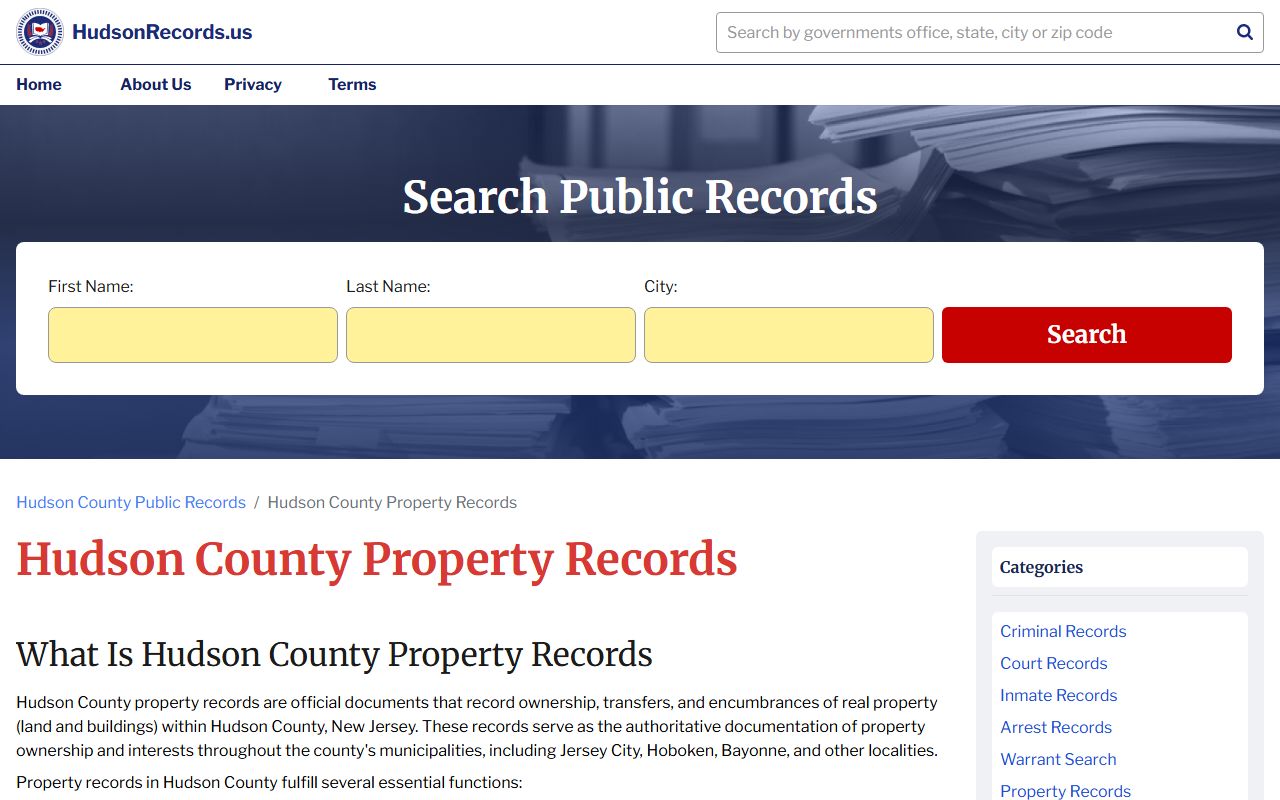
The state also runs a property tax data tool at nj.gov/transparency/property. This site lets you search by address and view tax bills for any parcel in Hudson County. It pulls from the same data that local assessors file each year.
Hudson County Clerk Property Records
The Hudson County Clerk records deeds, mortgages, and liens for all 12 towns. These documents form the chain of title for every parcel in the county. When a home sells, the new deed is filed here. When a bank issues a mortgage, that lien goes on record at this office. The clerk also files trade names and notary commissions, but for tax record research, the deed and mortgage index is the main tool.
The office provides an online document search at hudsoncountyclerk.org. You can look up recorded instruments by name, date, or document type. This is useful when you need to trace ownership changes that affect tax liability. Under N.J.S.A. 46:16-1.2, all deeds must be recorded in the county where the land sits.

| Office |
Hudson County Clerk Hudson County Plaza 257 Cornelison Ave, 4th Floor Jersey City, NJ 07302 Phone: (201) 369-3470 |
|---|---|
| Records | Deeds, mortgages, liens, trade names, notary commissions |
| Website | hudsoncountyclerk.org |
Jersey City Tax Assessor Records
Jersey City is the largest town in Hudson County and has the most property tax records to search. The tax assessor keeps data on every parcel in the city. You can search these records at taxrecords-nj.com by selecting Hudson County and then Jersey City. Enter a street address, owner name, or block and lot to pull up the file.
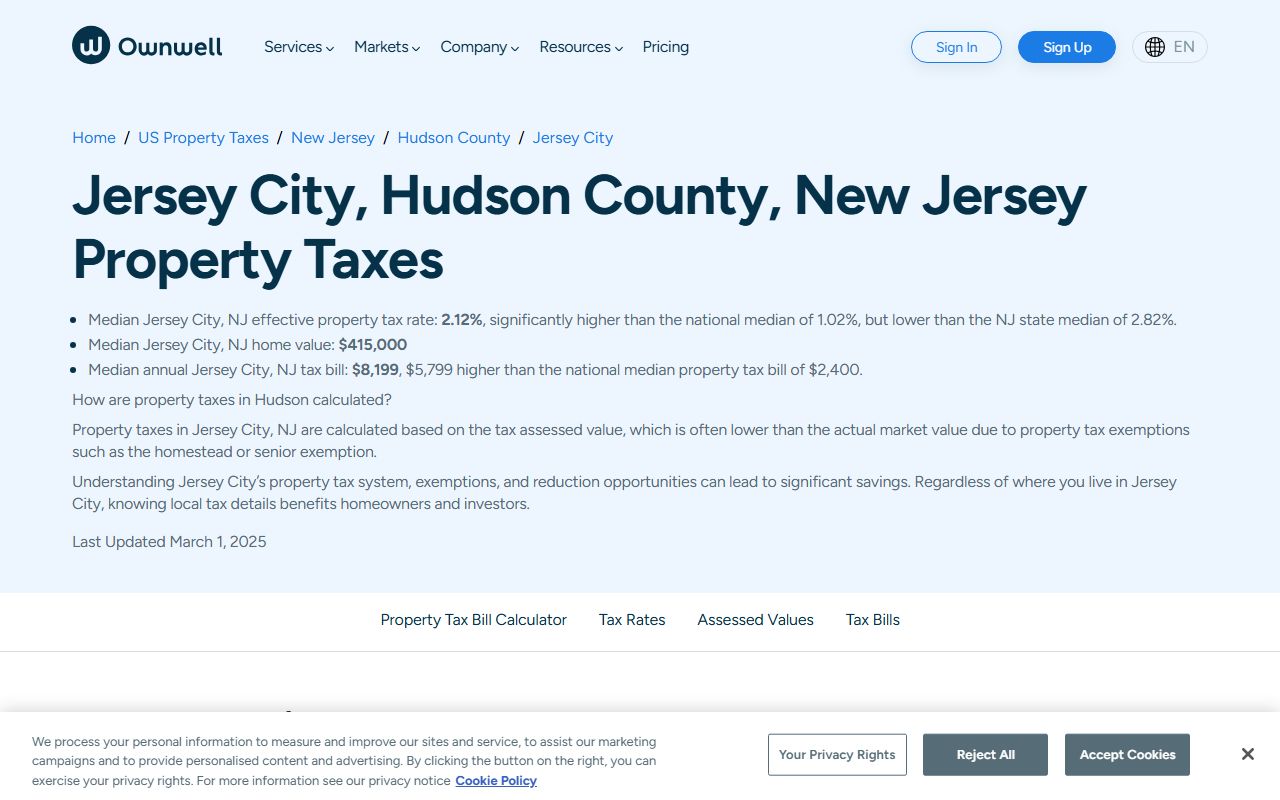
The median market value of a home in Jersey City is $415,000. The median tax bill is $8,199 per year. Tax bills range from about $5,926 to $16,951 depending on the neighborhood and property type. In the downtown 07302 zip code, the median value jumps to $732,050 with a median tax bill of $15,173. In the 07304 zip code, the median value is $319,800 and the median tax bill is $6,754. These gaps show how much location matters in Hudson County.
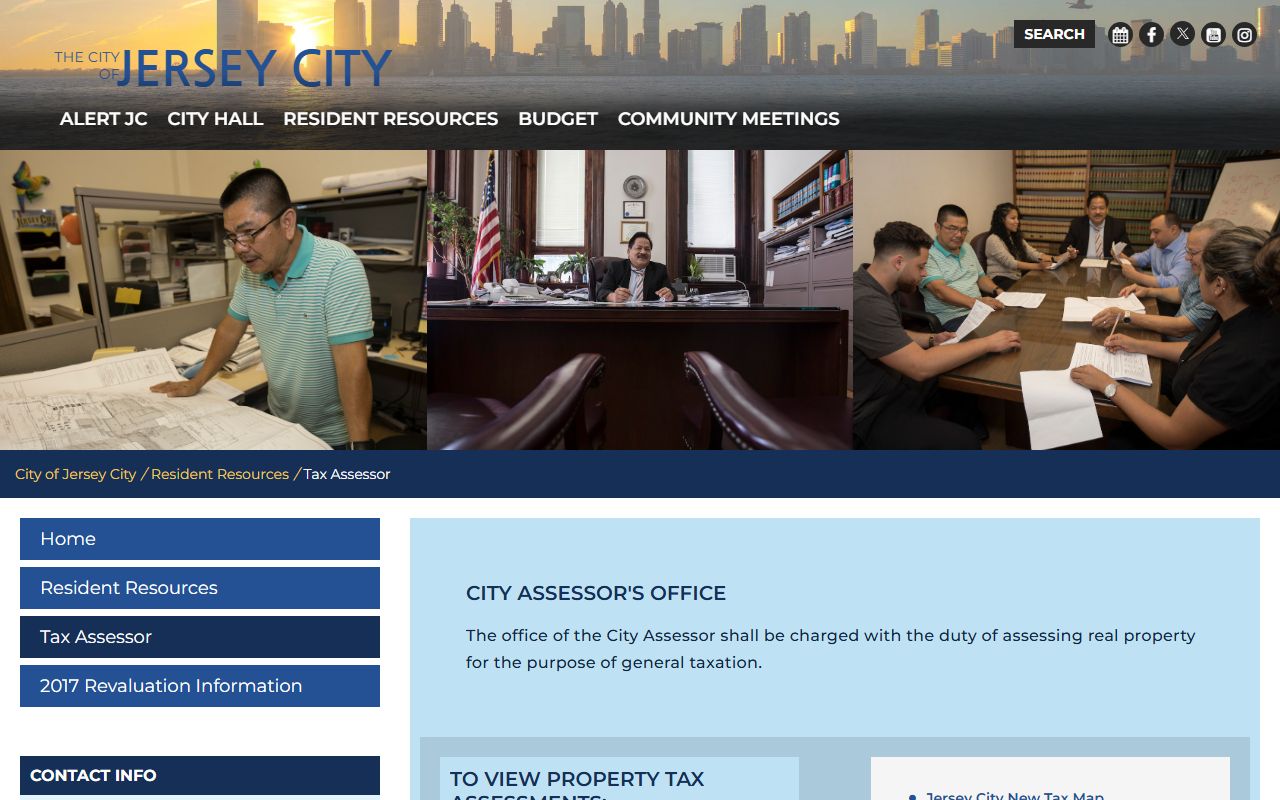
| Office |
Jersey City Tax Assessor 280 Grove Street, Room 116 Jersey City, NJ 07302 Phone: (201) 547-5131 |
|---|---|
| Website | jerseycitynj.gov - Tax Assessor |
Note: The Jersey City assessor sends updated assessment notices in spring, typically by mid-April. If your assessed value changes, you have the right to appeal under N.J.S.A. 54:3-21.
Hudson County Tax Rates
Each of the 12 municipalities in Hudson County sets its own tax rate. The rate has three parts: the municipal portion, the county portion, and the school district portion. The state publishes these rates each year after budgets are adopted. The effective rate across the county averages about 1.36%, which is one of the higher rates in New Jersey.
The equalization ratio matters when you compare assessed values to market prices. The county board of taxation and the state Division of Taxation publish these ratios each year under N.J.S.A. 54:1-35.1. A ratio below 100% means most properties are assessed below full market value. A ratio above 100% means the opposite. You can find the current tables for all Hudson County towns at nj.gov/treasury/taxation.
The average home in Hudson County is 81 years old and has about 1,943 square feet. About 36.6% of homes in the county are equity-rich, meaning the owner holds at least 50% equity. These figures shape how assessments play out across the 12 towns.
Property Tax Appeals in Hudson County
If you think your property is over-assessed, you can file an appeal with the Hudson County Board of Taxation. The deadline is April 1 of each year. In years when your town runs a revaluation, the deadline shifts to May 1. You can file online, by mail, or in person at the county tax board office.
To appeal, fill out Form A-1, which is the Petition of Appeal form. You must include comparable sales data to support your claim that the assessed value is too high. There is a filing fee that varies by assessed value. Under N.J.S.A. 54:3-21, any taxpayer may appeal their assessment to the county board. The board holds hearings and issues decisions. If you disagree with the county board ruling, you can take the case to the New Jersey Tax Court.
Gather your evidence before you file. Pull the tax record for your property and at least three comparable sales from your neighborhood. Photos of the property can help if there are condition issues that lower value. The board looks at all the evidence and makes its ruling.
Note: The appeal only covers the current tax year. If you want to challenge the next year, you must file again.
Hudson County Tax Deductions
New Jersey law provides several property tax deductions for qualified owners in Hudson County. Each deduction reduces your tax bill by a set amount. You must apply at your local tax assessor office and provide proof that you qualify.
- Senior citizen deduction: $250 per year for owners age 65 or older who meet income limits under N.J.S.A. 54:4-8.40
- Veteran deduction: $250 per year for honorably discharged veterans under N.J.S.A. 54:4-8.10
- Surviving spouse of veteran: $250 per year
- Disabled person deduction: $250 per year for permanently disabled owners
Full exemptions also exist. A totally disabled veteran may qualify for a complete property tax exemption under N.J.S.A. 54:4-3.30. Properties owned by churches and charitable groups may also be exempt under N.J.S.A. 54:4-3.6. These exemptions remove the property from the tax rolls entirely.
Union City and North Bergen Tax Records
Union City has a median tax bill of $9,994 per year. Bills range from $6,119 to $14,760 depending on the property. Union City sends assessment notices in the spring, usually by mid-April. You can search Union City records the same way as Jersey City: go to taxrecords-nj.com, select Hudson County, and pick Union City.
North Bergen Township uses the same search tools. The tax assessor office in North Bergen handles all local assessment questions. If you qualify, you can claim the same deductions listed above. The assessor checks eligibility and applies the deduction to your account.
Both towns follow the same appeal process through the Hudson County Board of Taxation. The April 1 deadline applies in both cases. Gather comparable sales and file Form A-1 to start your case.
Hudson County GIS and Zoning Maps
Hudson County maintains a GIS mapping system that shows property boundaries, zoning districts, and parcel data. This tool is helpful when you need to check a lot line or see what zone a property falls in. Zoning affects what you can build and how the assessor classifies the land.
The GIS system layers tax data on top of aerial maps. You can click a parcel to see the block and lot, owner name, and assessed value. The system also shows flood zones, which can affect insurance costs and property value. Use the GIS tool alongside the tax record search to get a full picture of any parcel in Hudson County.
Note: The GIS data updates on a schedule set by the county. It may not reflect the most recent deed transfers or lot splits. Always verify with the county clerk records for the latest ownership data.
How Hudson County Tax Bills Work
Property tax bills in Hudson County come out in two rounds. The first two quarters are preliminary bills based on the prior year total. The final two quarters reflect the new tax rate set after budgets are adopted. Under N.J.S.A. 54:4-66, taxes are due on February 1, May 1, August 1, and November 1. Late payments carry interest at 8% on the first $1,500 and 18% on amounts above that, as set by N.J.S.A. 54:4-67.
Your tax bill equals the assessed value of your property times the local tax rate. The assessment comes from the municipal tax assessor. The tax rate comes from the combined budgets of the town, the county, and the school district. If your assessment goes up or the rate goes up, your bill goes up. If either drops, your bill may go down.
Each municipality in Hudson County has a tax collector who handles payments. You can pay in person, by mail, or online depending on the town. Some towns charge a service fee for online payments. Check with your local tax collector for payment options.
Cities in Hudson County
Hudson County has 12 municipalities. Each one has its own tax assessor and tax collector. All property tax appeals go through the Hudson County Board of Taxation.
Other municipalities include Kearny, Harrison, Secaucus, East Newark, Guttenberg, and Weehawken. All follow the same county-level tax structure and appeal process.
Nearby Counties
These counties border Hudson County. Property tax rates and assessment practices vary by county. If you own property near a county line, confirm which jurisdiction handles your tax records.