
Cape May County Tax Records
Cape May County property tax records are stored across several local offices, with the County Clerk and Board of Taxation serving as the main hubs for public access. The county sits at the southern tip of New Jersey and has a population of about 95,263 residents spread across 16 municipalities. Cape May Court House is the county seat, where most tax and land record offices are based. Property owners, title professionals, and members of the public can search these records in person or through web-based tools maintained by county staff.
Cape May County Quick Facts
Cape May County Clerk Land Records
The Cape May County Clerk is the official custodian of all land records in the county. Under N.J.S.A. 46:26A-1, every instrument that affects real property must be recorded with the county clerk. This includes deeds, mortgages, liens, and easements. Recording these documents creates a public chain of title that protects property rights and gives notice to all parties. The clerk holds digital records for deeds from 1996 to the present, while older documents going back further are stored on microfilm.
The Clerk's Office provides a free online index search for land records. You can look up documents by party name, document type, or book and page number. Basic results show the names of the parties, the type of document, the date it was recorded, and the book and page reference. To get started, create a free account or use the guest login at the Cape May County government website. If you need a certified copy, the cost is $10 for the first page and $1 for each page after that.
| Office |
Cape May County Clerk 7 N Main Street Cape May Court House, NJ 08210 Phone: (609) 465-1010 |
|---|---|
| Hours | Monday through Friday, 8:00 AM to 4:30 PM |
| Website | capemaycountynj.gov/board-of-taxation |
Note: Public access terminals at the Clerk's Office let you search the index and view document images at no cost. Bring a form of ID if you plan to visit in person.
Board of Taxation Assessment Records
The Cape May County Board of Taxation oversees property assessment and equalization for all 16 municipalities. Each town has its own tax assessor who sets assessed values, but the Board of Taxation reviews those values at the county level. Under N.J.S.A. 54:4-1, all real property in New Jersey must be assessed at 100% of its true market value. The Board certifies the tax list each year and handles equalization ratios that affect how state aid and county taxes are split among towns.
The Board also hears tax appeals from property owners who believe their assessed value is too high. You must file an appeal by April 1 of the tax year, or within 45 days of the date on the assessment notice, whichever comes later. In a year when the municipality undergoes a revaluation, the deadline shifts to May 1. Appeals are filed on Form A-1 along with any supporting documents and the required filing fee. For properties assessed above $750,000, the appeal goes to the New Jersey Tax Court rather than the county board, per N.J.S.A. 54:3-21.
The Taxpayer Bill of Rights, enacted under P.L. 2017, c. 128, gives property owners the right to a clear explanation of how their assessment was calculated. You can ask your local assessor for a breakdown at any time.
| Office |
Cape May County Board of Taxation 7 N Main Street Cape May Court House, NJ 08210 Phone: (609) 465-1030 |
|---|---|
| Hours | Monday through Friday, 8:00 AM to 4:30 PM |
| Website | capemaycountynj.gov/board-of-taxation |
Searching Cape May Property Records Online
Cape May County offers several ways to search property tax records from home. The most robust tool is the county's consolidated records search, sometimes called PRESS. This system combines tax parcel data with land records and GIS map layers in a single interface. You can search by owner name, street address, or block and lot number. Results pull in assessment values, recorded documents, and links to interactive tax maps.
The state also runs the Online Property Record Search (OPRS) at nj.gov/transparency/property, which covers all 21 New Jersey counties. OPRS is free and shows the owner's name, property location, block and lot, and current assessment values. It also includes tax map references. This is a good starting point if you need quick facts about a property in Cape May County but do not need the full recorded documents.
For a broader look at New Jersey property tax law and how it applies across all counties, the state Division of Taxation publishes guidance at nj.gov/treasury/taxation. This page covers the legal framework, exemptions, and deduction programs that apply in Cape May County and statewide.
Note: The clerk's online index is free to browse. You only pay if you order copies or certified documents.
Cape May County Tax Maps
Tax maps are a key part of the property tax system. Cape May County maintains tax maps for each of its 16 municipalities. These maps show every parcel of land by block and lot number, which is the standard way New Jersey identifies real property for tax purposes. Maps are updated when parcels are subdivided, merged, or when boundary lines change. Under N.J.S.A. 54:1-18, county tax boards are responsible for ensuring map accuracy.
You can view tax maps through the county's GIS portal, which is linked from the consolidated records search. The interactive map lets you click on any parcel to see its block and lot, owner name, and assessed value. Paper copies of tax maps are also on file at each municipal tax assessor's office and at the county Board of Taxation in Cape May Court House.
Local Tax Assessor Offices
Each of the 16 municipalities in Cape May County has a tax assessor who is responsible for valuing all real property within that town. The assessor inspects properties, reviews sales data, and sets the assessed value that determines your tax bill. Assessors also process applications for deductions and exemptions, such as the senior citizen deduction, veteran deduction, and farmland assessment under the Farmland Assessment Act of 1964.
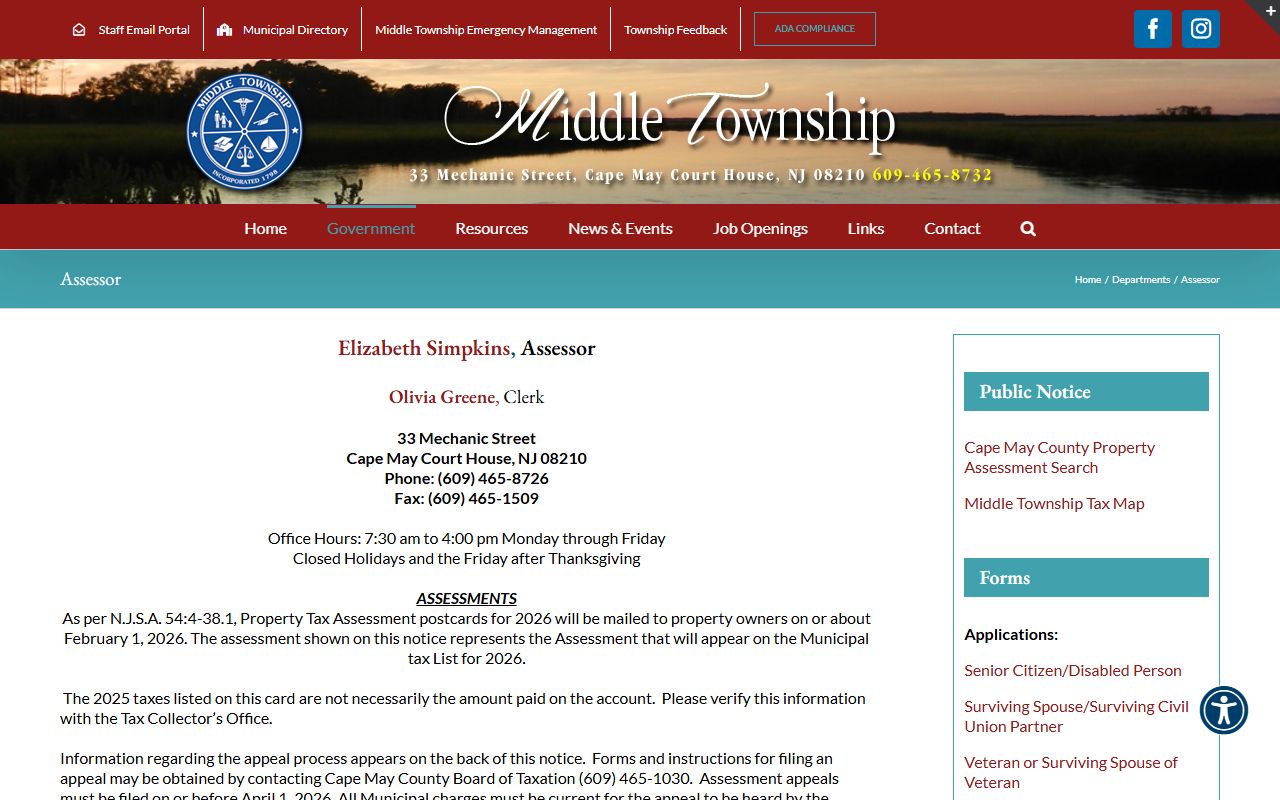
Middle Township, which includes the county seat of Cape May Court House, offers an online assessment search through its tax assessor's website. You can look up any property in the township to see its assessed value, owner of record, and lot dimensions. The site also has downloadable forms for senior and veteran deductions and links to the township's tax maps. Other municipalities in Cape May County offer similar tools, though the level of online access varies by town.
If you want to check the assessed value of your property, the local assessor's office is the best place to start. They can explain how the value was set and what comparable sales were used. You have a right to this information under the Taxpayer Bill of Rights.
Property Tax Deductions in Cape May
New Jersey law provides several property tax deductions that apply in Cape May County. The two most common are the senior citizen deduction and the veteran deduction. To qualify for the senior citizen or disabled person deduction under N.J.S.A. 54:4-8.40, you must be age 65 or older (or permanently disabled), own and occupy the property as your main home, and meet income limits set by the state. The deduction is $250 off your annual tax bill.
The veteran deduction under N.J.S.A. 54:4-8.10 provides a $250 annual deduction for honorably discharged veterans. You must own the property and live in it as your primary residence. There is no income limit for the veteran deduction. A surviving spouse of a veteran may also qualify. Applications for both deductions are filed with the local tax assessor in the municipality where the property is located.
Farmland assessment is another option for qualifying properties in Cape May County. Under the Farmland Assessment Act, land that is actively devoted to agricultural or horticultural use can be assessed at its value for that use rather than its full market value. This can result in a much lower tax bill for eligible parcels. The minimum requirements include at least five acres of land and $1,000 in gross sales from agricultural products in the year before the application.
Public Records Requests
Property tax records in Cape May County are public under the Open Public Records Act, N.J.S.A. 47:1A-1 (OPRA). Anyone can request access to tax records, assessment data, and land documents. You do not need to be the property owner or have any direct interest in the property. OPRA requests can be made in writing to the records custodian of the office that holds the records you need.
For most property tax records, you can get what you need without filing a formal OPRA request. The clerk's free online search, the OPRS system, and the Board of Taxation's records are all accessible to the public during normal business hours or via the web. A formal OPRA request is only needed if the records are not readily available through standard channels. You can also visit taxrecords-nj.com for additional search tools covering Cape May County and the rest of New Jersey.
Cape May Land Record Functions
Recorded land documents in Cape May County serve several critical functions in real estate transactions. They establish the legal chain of title, which is the sequence of owners going back to the original grant. Title companies search this chain when a property is being sold or refinanced to make sure there are no gaps, claims, or liens that could affect the new owner. Under N.J.S.A. 46:21-1, an unrecorded deed is still valid between the parties, but it cannot protect the buyer against a later purchaser who records first.
Recording also supports the tax system. When a deed is recorded, the county uses the sale price to help calibrate assessment ratios and identify properties that may be over- or under-assessed. This is one of the tools that local assessors in Cape May County use to keep valuations in line with the 100% true value standard required by N.J.S.A. 54:4-1.
- Deeds transfer ownership of real property
- Mortgages create a lien that secures a loan
- Liens reflect debts attached to the property
- Easements grant limited rights to use another's land
- Lis pendens provide notice of pending litigation
Municipalities in Cape May County
Cape May County has 16 municipalities. Each one has its own tax assessor and tax collector, but all fall under the Cape May County Board of Taxation for appeals and equalization. Property tax records for any town in the county can be searched through the county's consolidated system or at the individual municipal office.
Towns in Cape May County include Avalon, Cape May, Cape May Point, Dennis Township, Lower Township, Middle Township, North Wildwood, Ocean City, Sea Isle City, Stone Harbor, Upper Township, West Cape May, West Wildwood, Wildwood, Wildwood Crest, and Woodbine. Each of these towns maintains its own assessment rolls and tax collection records.
Nearby Counties
Cape May County borders three other New Jersey counties. If the property you are looking for is near a county line, check the address to make sure you are searching in the right jurisdiction. Tax records are kept at the county level, so you must search the correct county.